Superhydrophobic coating shields surfaces from hot water
A multilayered, insulated, superhydrophobic (MISH) coating reportedly repels water droplets even when they are approaching their boiling point.
Conventional superhydrophobic coatings that work at room temperature typically fail for liquids over 40°C, which can soak into the surface texture. This is problematic in operating conditions working with warm or hot liquids, such as food processing, desalination, chemical manufacturing and medical sterilisation workflows.
Engineers at Rice University, USA, have placed a thin, thermally insulating underlayer beneath an off -the-shelf, microtextured, superhydrophobic, spray topcoat. They claim this offers a low-cost, scaleable MISH system that is said to work up to 90°C. Sprayable polyurethane foam was chosen as the insulating material as it is easy to apply and allows tuning of the thermal resistance via changes to its thickness.
Assistant Professor Daniel J. Preston at the university says, ‘The insulation layer reduces cooling of the hot droplet at the interface, which…reduces evaporation and recondensation cycles that normally flood the surface texture with condensate.’
Previously, when a hot droplet hits a relatively cooler, hydrophobic surface, some of the droplet evaporates then recondenses inside the surface texture, forming tiny liquid bridges that replace the trapped air. Those bridges pin the droplet in place and drive a transition towards a stickier wetting state. That means hot water that should bounce or slide instead clings, spreads and leaves behind residue. In the new approach, less condensate means fewer liquid bridges.
The team performed several tests mimicking real-world conditions, including firing hot water jets at the MISH coatings and conventional ones. They reportedly found the insulated MISH remains less sticky when the temperature increases and can repel hot droplets for more than 80 hours before gradually degrading, compared to standard coatings that fail almost immediately.
Assistant Professor Zhen Liu, now at the University of Texas at Dallas, USA, adds, ‘A key challenge was isolating the effect of heat transfer and condensation from other factors that infl uence droplet behaviour, such as surface texture and chemistry. We kept [these factors] identical across all samples and varied only the thermal insulation layer beneath the coating.’
Preston adds that this tuning capability, without having to redesign the surface each time, ‘makes this approach easier to scale’.
‘The cost to apply our superhydrophobic coating is comparable to existing, commercially available…approaches that do not have the ability to repel hot water, and it is around 10,000 times less expensive than competing, nanofabricated, hot-water-repellent superhydrophobic coatings.’
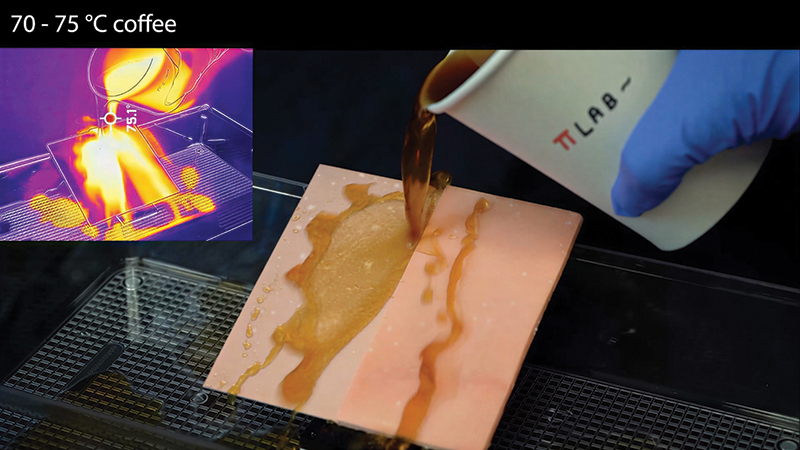
They have experimented on larger plates, curved surfaces, the inside of pipes, and even with hot milk, coff ee and split-pea soup. Hot liquids reportedly left less than 1% residue on MISH-coated surfaces compared to around 31% on standard coating.
Liu asserts, ‘The key message of our work is that thermal design can be just as important as surface chemistry or microstructure in controlling wetting behaviour.’
As well as the food and chemical industries, ‘one of the applications we are most excited about exploring…is handling of biological or biologically derived fluids’, suggests Preston.
An example is the ‘collection of astronauts’ urine in spacecraft …a longstanding challenge [due to] biofouling of the collection equipment’. Existing surfaces haven’t been able to repel the warm liquid, but Preston believes his team’s approach could off er a solution to this and similar problems.
‘We’re now looking at more insulating top layers, new coating architectures and manufacturing approaches that go beyond simple spray coatings,’ Preston concludes.