Unsinkable! Superhydrophobic etching keeps aluminium tubes floating
Metal tubes that stay afloat regardless of how long they are forced under water or how much damage they endure.
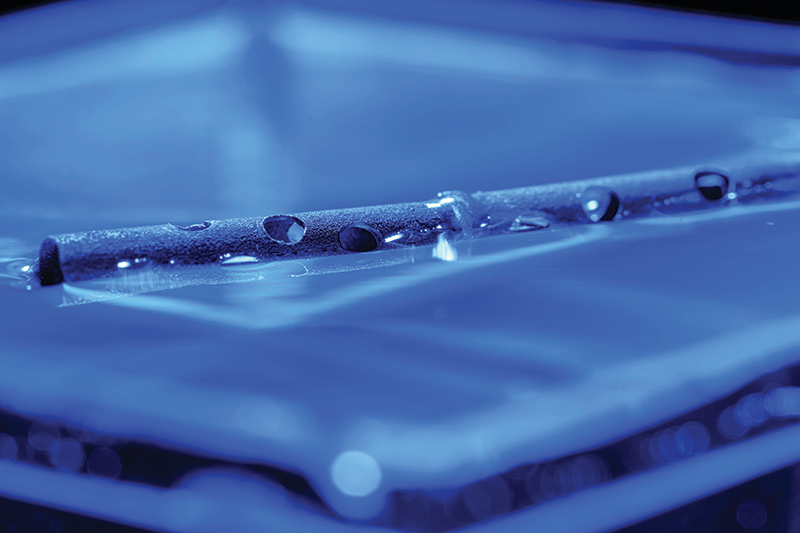
A chemically etched aluminium tube still floating, even after being severely damaged
© University of Rochester photo/J. Adam FensterThis could lead to more resilient ships, buoys, floating platforms and renewable energy developments.
A paper on Geometry-enabled recoverable floating superhydrophobic metallic tubes, published in Advanced Functional Materials, describes how the researchers at the University of Rochester, USA, claim to have etched micro- and nano-pits into the aluminium tubes’ interiors to render them superhydrophobic.
When they enter water, the etched surfaces trap a stable bubble of air inside, preventing them from gaining water and making them 'unsinkable', report the scientists.
The biomimetic mechanism imitates the hydrophobic behaviour of diving bell spiders and fire ants – the latter use this ability to form floating rafts.
The design has been tested on tubes of varying lengths – up to almost 0.5m. The researchers claim it can be easily scaled to larger sizes for building load-bearing floating devices. Floating rafts can be created by linking tubes together.
Existing self-floating technologies can only be used in smaller devices because their 'lack of mechanical strength and resistance to environmental stress' makes them prone to damage, say the inventors. However, this etched tube design reportedly shows 'strong resistance to mechanical abrasion and structural damage'.
Professor Chunlei Guo from the university says, 'We tested them in some really rough environments for weeks at a time and found no degradation to their buoyancy.
'We showed that even if you severely damage the tubes with as many holes as you can punch, they still float.'
Guo’s team first demonstrated self-floating devices in 2019. These featured two superhydrophobic discs sealed together to create buoyancy, but the tube design simplifies and improves the technology.
The discs would lose their floating abilities when turned at extreme angles, but the tubes are said to be resilient against turbulent conditions like those at sea and able to 'maintain buoyancy under severe tilting'.
'We added a divider to the middle of the tube so that even if you push it vertically into the water, the bubble of air remains trapped inside and the tube retains its floating ability,' emphasises Guo.
The team also demonstrates a floating, electrical-energy generator raft made from superhydrophobic tubes to harvest tidal energy from ocean waves.