Challenging 'misleading language' around plastic waste solutions
New study argues that words like 'upcycling' and 'downcycling' can skew value judgements.
A paper, authored by the Sustainable Materials Innovation Hub at The University of Manchester, UK, explores the consequences of terminology choices around end-of-life solutions for plastic waste.
While recycling has long been touted as a solution for plastic sustainability - it comes in many forms, and can sometimes 'serve as a smokescreen' for genuine discussions around sustainability.
The researchers, Seiztinger, Lahive, and Shaver, find directional terms - such as ‘upcycling’ and ‘downcycling’ - are poorly defined as value propositions, and that their use can skew perceptions of the benefits, potentially posing barrier to circularity.
‘Downcycling’, for instance, implies the production of a less favourable or ‘less good’ material as the end product of the recycling process, while ‘upcycling’ has positive connotations. However, despite what these terms suggest, a ‘downcycled’ stream may produce a high-value product, while an ‘upcycled’ path may have a greater negative environmental impact than alternative routes.
Using these terms assigns disproportionate value to certain end-of-life plastic solution strategies, and can be used by supporters or detractors of different recycling technologies to obscure genuine evaluation of their environmental impact.
The study, published in the journal Cambridge Prisms: Plastics, suggests that plastic waste solutions consistently fail to live up to their marketed messaging, and that clearer communication of the true value of the product from a recycling process is essential to drive investment in proper plastic waste management.
They suggest a ‘spiral system’ of reuse, in which plastic materials are treated as complex mixtures that, like crude oil, can be chemically deconstructed at the end of their life and transformed to become a huge range of longer-lasting products over their lifetime.
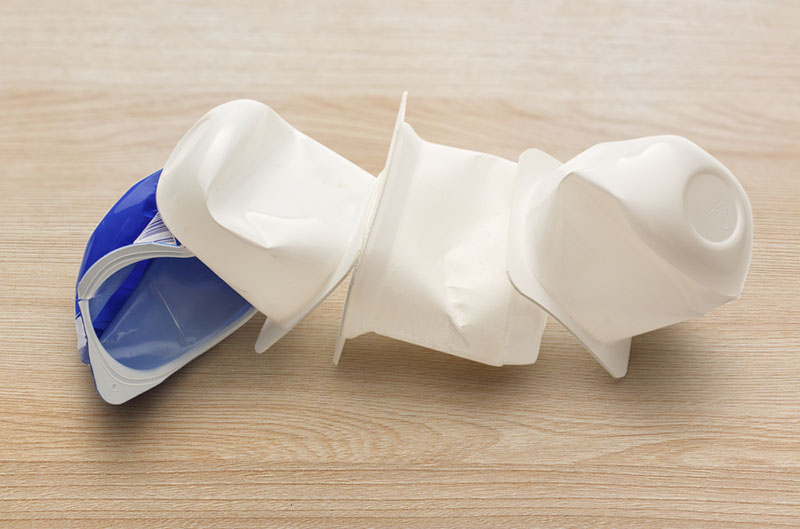
For example, a yoghurt pot could be reconstituted into car parts, and then after that into a park bench. Ultimately, after many years of service, it could be chemically deconstructed, and turned back into a yoghurt pot.
As the polypropylene in such simple packaging is already used in cars, hard shell suitcases, garden furniture, appliances, and plumbing, a cross-sector approach to reuse of plastic waste could generate more value than an approach focused solely on single-use packaging.
For more like this...