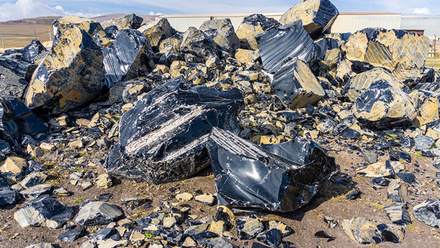
Bio-based vitrimer composites for wind turbine blades
Trials of an infusion process for manufacturing basalt-fibre-reinforced vitrimer-polymer composite laminates have reportedly been successful.
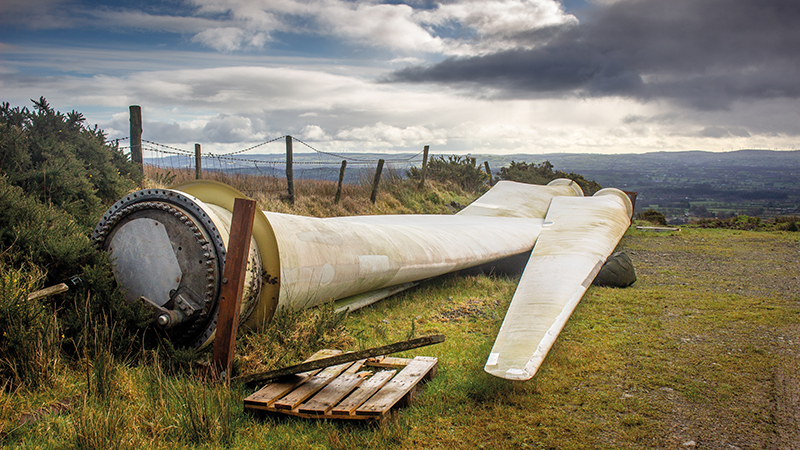
A used wind turbine blade. Vitrimer-based composites could reportedly enhance reusability, repairability and recyclability of these blades
© Gordon Dunn/ ShutterstockThe EU-funded project EOLIAN is working towards the production of a 12m-long, vitrimer-composite, demonstrator wind turbine blade to address the demand for bio-based composite materials. The aim is to substitute glass-fibre-reinforced thermoset composites currently used in blade production.
The researchers suggest that the properties of vitrimers – including repairability, reprocessability and recyclability – will contribute to enhanced sustainability throughout the blade’s lifecycle.
Vitrimers could pave the way to different end-of-life strategies, from reuse through thermoforming to chemical recycling that separates the fibre from matrix.
Project Coordinator Marco Monti from Proplast in Italy, says, ‘The fibre-reinforced composites currently used to manufacture wind turbine blades are not easy to recycle…vitrimers have emerged as a potential breakthrough solution.’
However, vitrimer’s high viscosity and short pot life typically makes infusion challenging. Monti says, ‘Wind turbine blades are typically made via vacuum infusion, which requires low-viscosity resins. Initially, our vitrimers were way too thick…[but] we’ve now developed tailored systems that find the right compromise between viscosity and final properties.’
He continues, ‘We utilise a vacuum infusion process, heating the mould to 40°C to facilitate resin flow.
‘Typically, the more complex the molecular structure, the higher the viscosity, often resulting in materials that are solid at room temperature [and that have a] higher glass transition temperature (Tg)…Wind blades must maintain a minimum Tg to comply with industry standards. The most challenging part of our work was tailoring the formulation with reactive diluents to reduce viscosity without dropping below the required Tg threshold.’
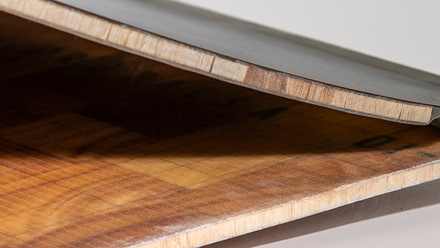
The joint team of Proplast and Politecnico di Milano, also in Italy, claims to have created basalt-fibre-reinforced vitrimer-based laminates at moderate temperatures between room temperature and 80°C.
Tekniker in Spain, a partner on the project, is synthesising the imine-based vitrimers from vanillin and epoxidised vegetable oils, which are commercially available at industrial scale.
The 60% bio-based composites reportedly demonstrate repairability and reprocessability, as well as an optimised, roughly 1:1 volume ratio of fibre to resin and low void content.
The team is continuing to refine the formulations to balance the composite’s bio-based content, processability and final performance.
It must satisfy the wind industry’s standards for performance, manufacturing, cost, thermo-mechanical properties and be scaleable.
Monti adds, ‘[The] repairability is incredibly exciting. When they break, you can repair them using just heat and pressure…you can hardly believe it.’
They are also developing a structural health-monitoring system to identify blade damage earlier. This involves in-mould electronics processes to embed erosion- and ice-detection sensors into the composite. The sensors could help extend service life, maintain performance and safety, and reduce maintenance costs.
Another partner in Italy, AEP Polymers, will explore how to adjust the process for scale-up.
Spanish renewable-energy company Norvento Enerxía will manufacture a prototype, sensor-assisted, vitrimer-composite blade, so it can be benchmarked against a glass-fibre-reinforced, epoxy-composite blade.
A detailed Levelised Cost of Energy analysis and Life Cycle Assessment will also provide more insight into the composite’s benefits.
Monti believes, ‘Once the technology is industrially proven, traditional thermoset producers will start making epoxy vitrimers too, which will naturally drive costs down and increase availability.’
He thinks vitrimers could be useful in other areas too, ‘for example, adhesives could be a very interesting field…imagine an adhesive that can be debonded or repaired on command. We’re starting with wind blades, but any sector using composites could benefit, especially automotive, where regulations on end-of-life management are getting stricter’.