Arsenic sludge turned into material for semiconductors
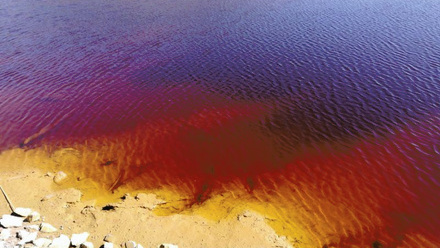
Toxic arsenic sludge from groundwater treatment or mine tailings could be converted into a semiconductor material.
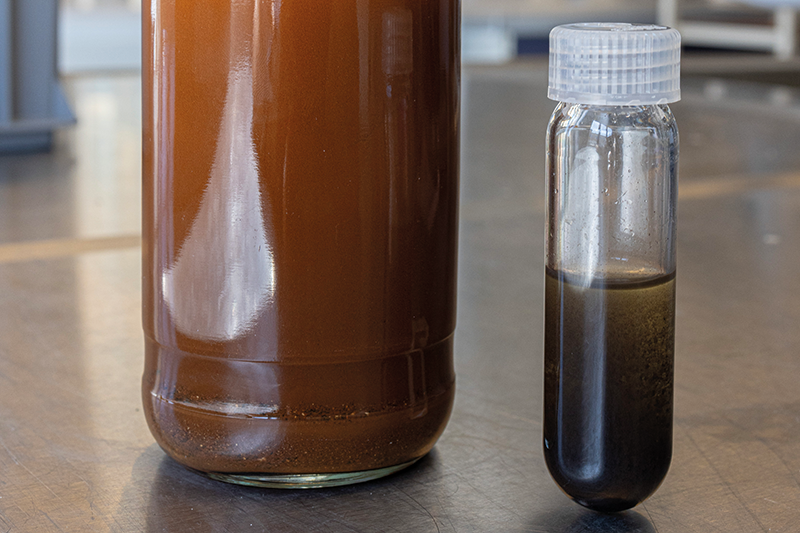
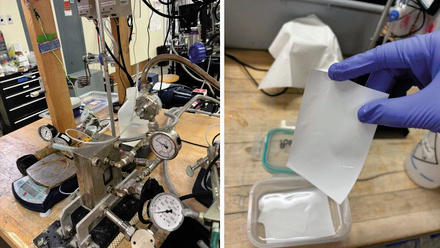
Sludge obtained from an existing treatment plant in Denmark (left), which is brown due to the high iron content. On the right is upcycled metallic arsenic As(0), shown for comparison
© Geological Survey of Denmark and Greenland (GEUS)Groundwater can be treated to remove arsenic for drinking, but the leftover sludge remains toxic, as does arsenic in mine tailings. Scientists at the Geological Survey of Denmark and Greenland saw a potential opportunity to valorise arsenic waste.
Dr Case van Genuchten and postdoctoral researcher Kaifeng Wang have developed a chemical process to produce the metallic form of arsenic – As(0) – from such waste for use in batteries, semiconductors and other technologies. The technique forms a glassy, rather than crystalline, metallic arsenic.
The required chemicals include sodium hydroxide (NaOH) and thiourea dioxide (TDO) heated to 70-80oC. Van Genuchten stresses, “No sophisticated reactor vessels are needed.”
Arsenic-laden groundwater treatment waste, which consists of arsenic adsorbed to iron oxide solids, is mixed with NaOH to extract arsenic from the mixture, “leading to a solution with high pH and rich in aqueous arsenic”, Van Genuchten says.
Then “a selective reductant is added to the arsenic-rich solution to reductively precipitate aqueous arsenic to form As(0)”. The reductant subsequently transforms mainly to urea, sulphite and sulphate after the reaction. Van Genuchten asserts, “These aqueous by-products are far less toxic than the initial arsenic-laden waste.”
In optimal conditions, “we can reductively precipitate more than 99% of arsenic extracted from the sludge as As(0). However, there is a trade-off because this high conversion efficiency also requires high reductant concentrations. In other words, less reductant can be used if lower conversion efficiency is acceptable.”
Another factor in the yield is the sludge’s initial arsenic content. The higher the content, the higher the concentration of the extraction solution and conversion efficiency.
“Therefore, there is a real benefit to create groundwater treatment systems that yield the highest arsenic content of the sludge because this facilitates As(0) upcycling,” Van Genuchten points out.
One fundamental property of arsenic that renders it useful for semiconductor synthesis is its position on the periodic table – it has the right kind of electron configuration.
“The standard, arsenic-bearing semiconductors include the III-V materials, indium arsenide (InAs) and gallium arsenide (GaAs). However, there are also non-conventional arsenic-bearing semiconductors that are intriguing alternatives to standard III-V materials,” he explains.
They are collaborating with arsenene synthesis expert Weimin Wang at Lund University, Sweden, to create advanced functional materials from arsenene. It is a pure As(0) 2D material that has “fascinating semiconductor properties”.
Van Genuchten concludes, “Our group recently started to actively research new approaches to manage this waste, but it was not until arsenic was classified as a critical raw material four-to-five years ago that the idea to convert the waste into metallic As(0) became tangible.” This classification in the EU has been key to progressing the research because the societal value of As(0) is increasing.
A project running over the next three years will seek to upcycle arsenic-laden waste from different groundwater treatment plants across Europe and produce arsenic-bearing semiconductors with the upcycled material. A modular reactor will be developed to test large-scale conversion onsite.
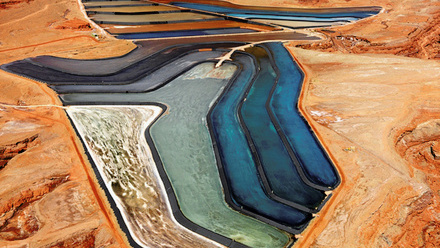
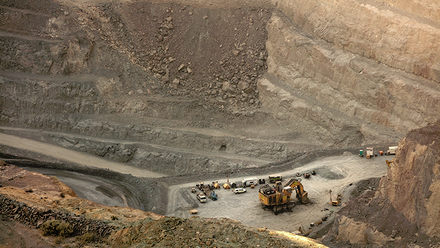
The team also plans to test the process on different types of legacy arsenic waste, including industrial and mining waste.