Upcycling acid mine drainage
Ferric iron (Fe(III)) extracted from acid mine drainage (AMD) is being converted into a chemical for water treatment.
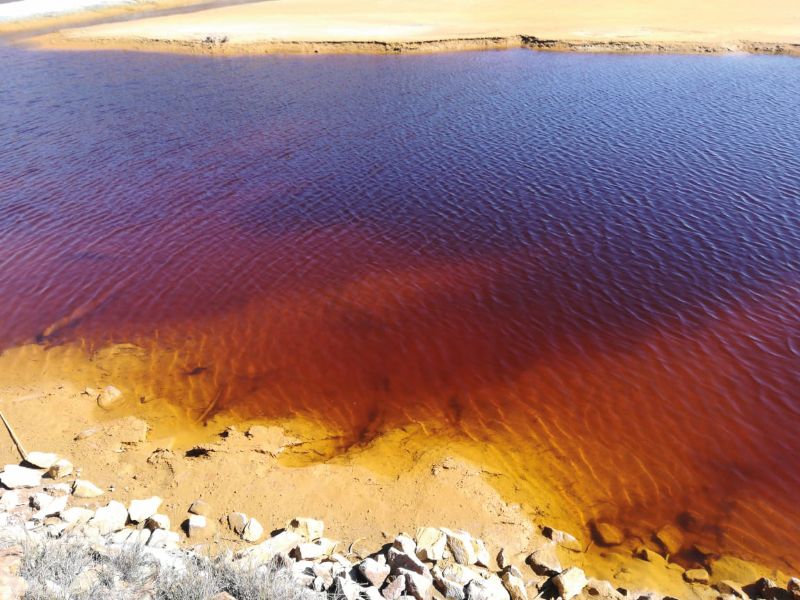
The AMD-derived ferric chloride (FeCl3) is said to have achieved removal rates of more than 99% for river water pollutants such as aluminium, iron and chromium. This could improve the AMD’s quality for potential water reclamation.
The researchers from Heriot-Watt University, UK, and the University of South Africa (Unisa) claim the treated water meets South Africa’s drinking water standards under SANAS/ISO/IEC 17025 accreditation.
The study used mine water collected from an active coal mine in Mpumalanga, South Africa.
'Active and derelict coal and gold mines in South Africa discharge close to 400mln litres of AMD per day,' says Professor Vhahangwele Masindi from Unisa.
'Conventional neutralisation treatment can be expensive, while it also creates secondary pollution in the form of a highly toxic sludge. For this reason, attempts are underway to turn this problematic effluent into a valuable resource. Here, circularity and waste-to-resource paradigms were introduced by recovering the dissolved aluminium and particularly iron from AMD and using them to produce industrial-grade coagulants for water treatment.
'This not only improved the quality of acid mine drainage, opening up opportunities for water reclamation, but also provided a valuable industrial product that was used to treat another wastewater matrix, here municipal wastewater.'
He adds, it could 'transform a major environmental hazard into an economic opportunity' that addresses water scarcity and benefits communities near polluted mining areas.
The team precipitates Fe(III) from AMD using magnesium oxide nanoparticles that are produced through calcination of locally available cryptocrystalline magnesite. The Fe(III) reacts with hydrochloric acid to form FeCl3.
The coagulant produced is said to perform contaminant removal as well as, or even better than, its commercially available counterpart. Although performance typically depends on the type and characteristics (e.g., pH) of wastewater, as well as metals loading.
The decontamination performance is attributed to enrichment with other cations such as aluminium.
The by-product of nutrient-rich ‘flocs’ waste can also be gathered and dewatered for recovery as struvite or phosphoric acid. Flocs can be fed to anaerobic digesters to produce biogas, as their high iron content is beneficial for acidity control.
Since this method relies on 'locally and readily available materials', 'the community could easily adopt and employ the technology if properly trained', adds Masindi.
Dr Spyros Foteinis from Heriot-Watt University says the findings show how mining regions around the world could benefit. 'We’re demonstrating that even highly contaminated mine water can be cleaned up. This could be a low-energy and low-carbon solution to a problem that blights communities around the world.
'The scaling up of this sustainable technology can underpin global efforts to manage industrial waste more sustainably and advance the global effort for clean water and sanitation for all.'
The team believes their method could be applied at industrial scale, particularly for countries affected by legacy mining pollution. Their next steps include upscaling the technology and piloting its use in rural and peri-urban communities in South Africa – and further afield – that struggle with water scarcity pressures, subject to techno-economic and sustainability evaluation.