Low-cost graphene from nanocellulose
Nanocellulose converted into biochar can reportedly be used to produce high-quality graphene.
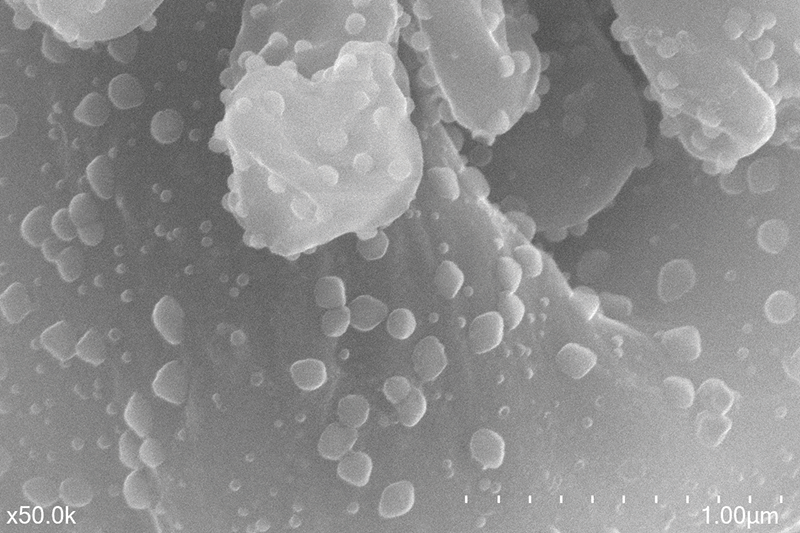
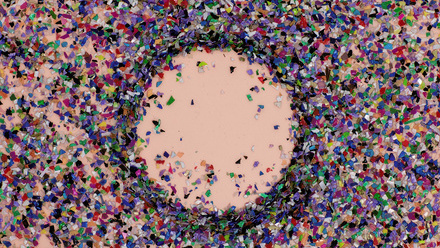
A micrograph of the pyrolysed nanocellulose biochar taken at 50,000x magnification using scanning electron microscopy
© James Cook UniversityResearchers from James Cook and Flinders Universities, Australia, have collaborated to transform the agricultural by-product into graphene using a patented vortex fluidic device (VFD), renewable materials and water, without harsh chemicals or catalysts.
PhD candidate Yu Matsueda, from James Cook University, says the high-speed rotation of the patented VFD 'allows us to really control the way fluids move inside the device. Thus, we can control the layers of graphene formed from the initial biochar'.
The biochar is produced via pyrolysis of biomass-derived nanocellulose crystals (NCCs). The NCCs are pyrolysed by heating between 500 and 800°C, at a rate of 5°C per minute, for 60 minutes, before being 'converted to graphene in the VFD using only water as the solvent', reads the paper on Conversion of renewable lignocellulosic biomass-derived nanocellulose into graphene via pyrolysis and high shear-mediated exfoliation, in the journal Small Structures.
High-value graphene is typically obtained from mined graphite. Matsueda says, 'Current production methods…are costly and require quality graphite…The lack of a sustainable way to produce graphene significantly increases its cost and really limits its potential,' despite having potential in 'water purification, materials science, aerospace, electronics and batteries. As such, we looked to try and find an alternative method to make graphene, making it more accessible and unlocking its full potential'.
'The graphene we produced was, in fact, very similar to what other people are obtaining from non-renewable resources,' continues Matsueda.
In the paper, they describe their VFD as a low-cost 'thin-film processing platform' that 'rapidly rotates a tube [at] up to 9,000rpm, [and] at an angle to form a thin, [~0.22µm-thick] film of liquid…at the tube surface' using high shear forces. They add that the device typically houses a small quartz or borosilicate glass tube but claims it can be scaled up.
The challenge was understanding how their process conditions affect graphene production and its quality. To optimise the method, they applied scanning electron microscopy and UV-VIS spectroscopy to characterise the material produced.
The team tested the specific surface area, defects and layer thickness of the resulting material, finding 600°C to be the optimal biochar pyrolysis temperature. In the VFD, the optimal conditions reported in the paper are 7,000rpm and a residence time of 120 minutes in the north direction of Earth’s magnetic field, with counterclockwise rotation.
The paper says the resulting graphene is 'relatively high quality, with an ID/IG ratio of 0.60' indicating a low number of defects, while 'an I2D/IG ratio of 0.15' shows it is 'predominantly composed of few-layered graphene'. This is said to be higher quality than other types of graphene such as graphene oxide and reduced graphene oxide.
The process’ energy consumption at ~28,980MJ/kg is also lower than traditional chemical exfoliation (~35,810MJ/kg), one of the most common graphene production methods.
The team also 'works heavily with ceramic materials', so Matsueda explains that they are keen to develop 'new graphene-ceramic composites with enhanced properties for industrial applications such as aerospace'. He says they have been in contact with several companies to advance the work.