Impermeable polymer film protects against corrosion
The coating could prevent corrosion of solar cells and other infrastructure, as well as slow the ageing of packaged food and medicines.
The disc-shaped, amide-based molecules are held together by hydrogen (H)-bonds. The alignment and stacking of the discs into a film through spin coating reportedly creates a strong, stable, nanometre-thick coating impermeable to nitrogen gas and other molecules.
The coating is synthesised from melamine monomers, which contain a ring of carbon and nitrogen atoms.
Typically, when the 1D molecular strands of polymers pack together, they leave gaps called ‘free volume’ that allow gas molecules through. Researchers from MIT, USA, claim this is the ‘first, 2D, [organic] polymer of its kind…to show essentially no permeability’, rivalling covalently bonded and crystalline materials such as graphene.
Professor Michael Strano shares that the material 2DPA-1 is ‘produced from a solution-phase polymerisation reaction, but…behaves like graphene, which is gas-impermeable because it’s a perfect crystal’.
While ‘a little patch of graphene is molecularly impermeable’, it doesn’t scale up well, as it ‘slides when sheared’, explains Strano. 2DPA-1 sticks together easily because of its strong H-bonds.
The MIT team finds a layer just 60nm thick could extend the lifetime of a perovskite crystal by about three weeks and thicker coatings offer even longer protection. This could help perovskite solar cells better compete with silicon-based panels.
Strano continues, ‘You could [also] protect infrastructure such as bridges, buildings, rail lines [from corrosion]… anything outside, exposed to the elements. Automotive vehicles, aircraft and ocean vessels could also benefit…The shelf life of food and medications can also be extended.’ The team first reported the self-assembling polyaramid material in 2022.
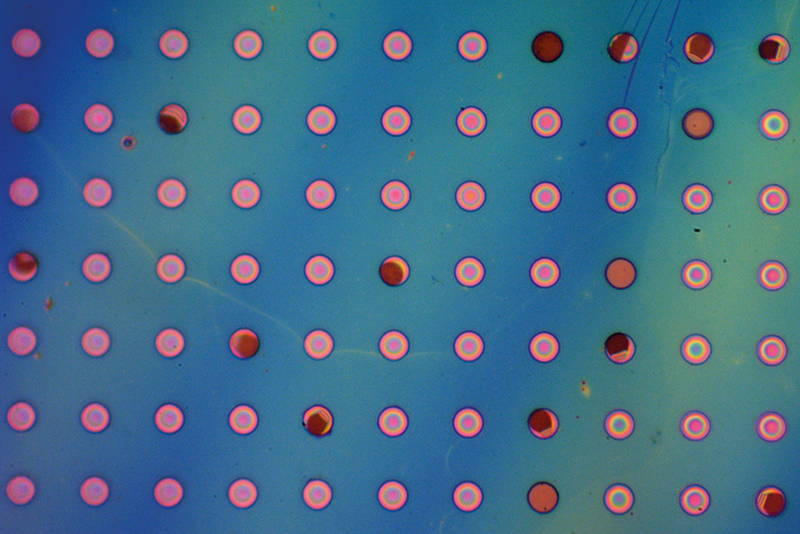
‘We set up a series of careful experiments to first prove that the material is molecularly impermeable to nitrogen…We had to make micro-bubbles of the polymer and fill them with a pure gas like nitrogen and then wait,’ adds Strano.
With most polymers, trapped gases quickly seep out of the material, causing bubbles to deflate. However, the researchers observed that the 2DPA-1 bubbles did not collapse, and some of the bubbles created as long ago as 2021 are reportedly still inflated.
The 2DPA-1 samples were also exposed to helium, argon, oxygen, methane and sulphur hexafluoride, with at least 1/10,000 the permeability to these gases than any other existing polymer – nearly as much as graphene.
The other application demonstrated with the material is a nanoscale drum resonator – a tiny drum that vibrates at a particular frequency, which could be scaled up to sensors and electromechanical devices.
Larger resonators (<1mm) in cell phones pick up frequency bands for transmitting and receiving signals, but they can also be used as sensors for extremely small molecules. Strano says the nanoscale resonator could help make these devices smaller and ‘reduce the power expenditures needed for signal processing’.
The film has not yet been scaled up, although the team believes large quantities can be produced as melamine is low-cost and already produced at a large scale globally. They are looking into commercialisation opportunities.
More like this...