Nanoengineered polymer paint harvests water from air
The paint-like coating can reportedly cool buildings passively without additional energy or water.
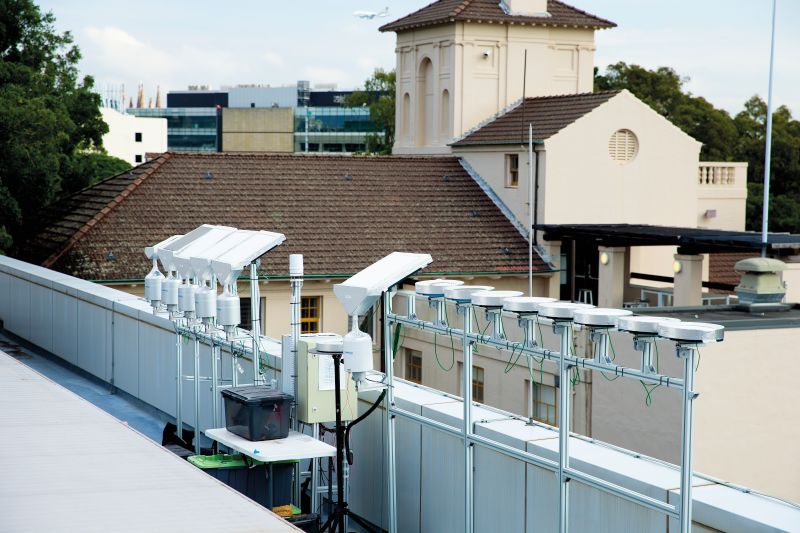
Researchers at the University of Sydney, Australia, and start-up Dewpoint Innovations have developed a porous polymer coating. They say it reflects up to 97% of sunlight and radiates heat into the air, keeping surfaces up to 6ºC cooler than the surrounding air, even under direct sun.
This process creates conditions for atmospheric water vapour to condense into droplets on the cooler surface, the way steam condenses on a bathroom mirror.
Unlike traditional white paints, the coatings are made of polyvinylidene fluoride-co-hexafluoropropene (PVDF-HFP) and do not rely on UV-reflective pigments such as titanium dioxide.
'Our design achieves high reflectivity through its internal porous structure, delivering durability without the environmental drawbacks of pigment-based coatings,' says Dr Ming Chiu, Chief Technology Officer of Dewpoint Innovations.
'By removing UV-absorbing materials, we overcome the traditional limit in solar reflectivity while avoiding glare through diffuse reflection. This balance between performance and visual comfort makes it easier to integrate and is more appealing for real-world applications.'
PVDF-HFP was chosen because it is 'chemically inert, mechanically robust and has a high emittance in the atmospheric window', according to the research team.
A liquid film of the material is applied on a solid substrate by a doctor-blade (usually used in paint coating). In the drying process, the layer phase separates into a nanoporous material. The dense nanopores in the film scatter UV and visible light to keep the film cool, without the need for light pigments.
Over the six-month outdoor trial, the team recorded cooling and water collection data minute-by-minute, confirming robust performance with no degradation under the harsh Australian sun.
Professor Chiara Neto, at the University of Sydney, says, 'The maximum rate of water we collected [was] around 400ml/m2/day, produced by a typical cooling of the surface of 2-3ºC below air temperature. This passive daytime radiative cooling (PDRC) effect delivers much cooler roofs for buildings compared to black roofs (typically over 25oC cooler than a black roof during the daytime) and superior even to conventional light-coloured materials (typical reflectance of only ~70%), leading to much lower heat loading for buildings and a strong reduction in the heat island effect.'
Neto continues, 'When applied on the roof of a building, the material could reduce the need for air conditioning, because it decreases the heat load of the building. The exact extent of cooling will depend on the specifics of the roof, in particular the extent of insulation present, number of windows, occupation, sun exposure and so on, but it has been shown that cool roof paint similar to ours could lead to 2-4ºC cooler rooms under the roof, and much reduced radiative heat.'
To bring the discovery from the lab to rooftops, Dewpoint Innovations is now developing a water-based paint formulation that can be applied using ordinary rollers or sprayers.
They state, 'The paint adheres readily to a wide range of substrates, it has excellent robustness to soiling, it dries quickly and can be produced at reasonable cost with standard paint equipment.'
Water obtained by condensation from the atmosphere is also said to be drinkable after filtration and disinfection, as the main contaminants arise from the aerosols in the air surrounding collectors.
The researchers report that dew could be collected for a third of the year and could provide a sustainable and predictable supply of water even in periods without rain. Under optimum conditions, they suggest the coatings can harvest up to 390ml of water per square metre daily.