Following the heart
Professor Ipsita Roy FIMMM, at the University of Sheffield, UK, is passionate about creating medical devices from bacteria-derived polymers.

Hailing from a family of artists in New Delhi, India, Professor Ipsita Roy FIMMM’s journey into the sciences, let alone materials science and, more specifically, biomaterials research and tissue engineering, was by no means predictable.
‘My mum was a musician. My father was an artist. So going into science wasn’t the thing to do…it was quite unusual,’ she reflects on those early years. ‘But I just got drawn to science.’
She credits ‘fantastic’ teachers at Carmel Convent School in New Delhi for her love of Chemistry and Maths, saying the subjects to her felt ‘like playtime’, while she also enjoys art, music and dance.
Roy emphasises that, while there was encouragement, she didn’t feel pushed into science by anyone. Nor did societal pressure play a part in her decision to pursue scientific studies beyond school. She simply enjoyed the subjects.
She says fondly, ‘My parents never ever made me feel that being a girl, you cannot do this. We never spoke about anything like that, so I have to thank them that I grew up with that sort of attitude – my mother was a professional too.’
Her father advised her to continue with science in university, as she could always return to the arts. She ended up getting a place at St Stephen’s College, a constituent of Delhi University, where she studied for a Chemistry bachelor’s degree.
‘The undergraduate degree was absolutely the best time I had in my life. Being in one of the best colleges, it was a very competitive environment, and that nurtured a bit of competitiveness in me.
‘We were taught extremely well, we had the best teachers and the library was very well stocked with all the books we needed. We had the right tutorials, labs – everything was just superbly arranged at St Stephen’s. I finally ended up getting the first position in the whole university in Chemistry out of about 5,000 students. In India we call them the ‘gold medallists’. That was really a highlight.’
Now Deputy Research Director at the School of Chemical, Materials and Biological Engineering at the University of Sheffield, UK, Roy has traversed country borders and science disciplines to make her mark.
Seeds of interest
During her Chemistry undergraduate degree, organic and quantum chemistry classes were Roy’s favourite. She mentions again, ‘I was really blessed to have extremely gifted teachers.’ She was particularly inspired by a poster she made on beta-lactam antibiotics. ‘This is where Biology came into my life.’
Wanting to pursue a degree linked to Biology that still involved Chemistry, a Biotechnology Master’s followed. It was a ‘new buzzword’ at the time. Here, molecular biology classes piqued Roy’s interest. She describes how her professor didn’t just teach them the facts, but rather drew out interesting points about the history of the discovery of DNA and how it works.
On completion of her Master’s, Roy applied for a PhD, with her interest split between biochemistry and biophysics. She was awarded an Inlaks scholarship, through which she applied to the University of Cambridge, UK.
‘They didn’t quite have a PhD in biophysics, so I applied for biochemistry at Churchill College. It wasn’t a materials-oriented PhD, it was about enzymes. I was looking at the active site of the enzyme – site-directed mutagenesis.’
This is ‘where you change one amino acid to another in the active site and see what happens, whether it can still catalyse the reaction. The enzyme I was looking at had two cysteine (amino acid) residues, which was thought to be where the active isomerisation reaction happened’.
She worked on changing each of the two cysteines in these reactions into an alanine, theorising that it should become inactive.
Much like her time at St Stephen’s College back in India, it is clear Roy was inspired by her surroundings, praising the well-stocked library and excellent teachers. ‘Of course, in the PhD, we didn’t have any required, taught courses, but I sometimes attended my supervisor’s lectures on enzymology.’
She calls Cambridge ‘a beautiful little town’ that is ‘very academically stimulating’ and an ‘inspirational place where you can learn a lot’, referencing opportunities to hear talks from prominent researchers like Francis Crick and Stephen Hawking.
‘It was a wonderful experience, academically and personally, and there was so much art happening.’ Roy even joined the Art Society to continue exploring her creative side.
Happy accidents
For further progression in her research career, Roy opted for a postdoctoral position at the University of Minnesota, USA, where she stumbled across the biodegradable polymers polyhydroxyalkanoates (PHAs).
‘All the labs on the same floor would meet up and present their work, and just by chance, the lab opposite mine was working on these polymers called PHAs. They were optimising and modelling the fermentation process to get block copolymers. I used to find it quite fascinating.’
At the time, she was working on fatty acid synthase, while another post-doc in the group was working on PHA synthase – the enzyme that produces PHAs in bacteria. ‘People were looking at environmentally friendly applications like packaging. I was intrigued by this whole thing.’
The natural polymer nicely cross-linked her interests in Chemistry, Biology and sustainability, so when she moved back to India to work at the Indian Institute of Technology (IIT) Delhi, it was an organic pivot to turn her attention to PHA synthase, and a passion was born. ‘It had stuck in my mind from that initial encounter.’
Her first PhD student worked on cloning the gene coding in PHA synthase. That work continued when she relocated back to the UK, taking on her first lectureship at the University of Westminster. Her group focused on the genes in Streptomyces bacteria, which she says ‘no one had yet looked into’.
During this time, Roy had two female A-level students join her team on a summer placement scholarship. ‘At that point, we were still working on the genes, but I was still thinking about this polymer. So, I gave them a series of bacteria from the culture collection in Westminster to grow and try to produce PHAs from.
‘They were both brilliant and did a fantastic job, with the help of my PhD student. Then, in about a week, by which time the summer students had left, my PhD student came in with an image of a highly fluorescent microscopic slide.’
When stained with Nile Blue A, PHA is known to exhibit bright orange fluorescence. She recalls, ‘He came back with the developed photo, which was bright orange! I still remember it vividly.’ This breakthrough was much needed, ‘because we were struggling with Streptomyces. It wasn’t producing many results – we weren’t able to get the genes’.
This led to her segue into materials science. With support from Imperial College’s materials science department, Roy stepped into the world of biodegradable polymers and composites.
Her collaborator was working with osteogenic Bioglass, produced by the late Professor Larry Hench, known for his discovery of this glass, which can bond with living tissues. ‘That collaboration began my journey towards tissue engineering.’
Roy proposed a collaboration to develop PHA-Bioglass composites for biomedical applications and eventually secured an Engineering and Physical Sciences Research Council grant for the project. ‘My collaborator was an excellent mentor. He was really good with publications and I learned a lot from him.’
The pair started working together in this space more than 20 years ago, ‘and I never stopped – I just love the area so much. It was so organic. I didn’t plan it in any way’.
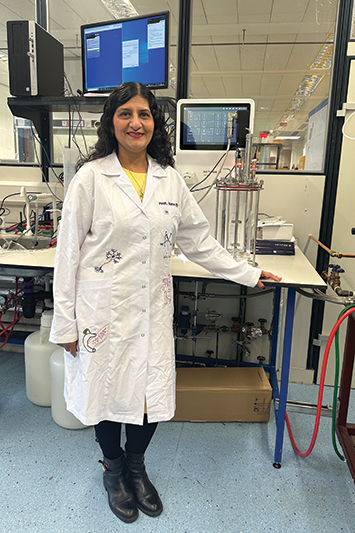
Roy in her current lab set-up at the University of Sheffield, UK
© Professor Ipsita RoyOne answer to many problems
She has since worked on tissue engineering in the heart, lungs, pancreas and kidney. ‘I try and aim the technology at all the organs and tissues in the body,’ she explains.
Roy finds 3D and 4D printing particularly fascinating, ‘where we can tailor the shape. I love the functionality, that we can repair tissue. I hope one day we can actually get a whole organ made, like a functional heart. It’s not easy, but doable – we have to aim high.’
She describes PHA as a ‘toolbox’ with a ‘huge number of applications. Most of the world is using PHAs for packaging, coatings, or bottles…environmentally friendly applications. I have mainly focused on biomedical and medical applications.’
Besides tissue regeneration, her current work includes production of medical devices such as stents and scaffolds, functional in vitro assays in cells, and 3D in vitro models for diseases like cancer.
She is also investigating natural polymers like bacterial cellulose, alginate and gamma-polyglutamic acid. ‘These are hydrophilic, so I can mix them with hydrophobic polymers to make single- or multi-material patches and structures, depending on the need.
One of Roy’s favourite applications is the nerve guidance conduit – a tubular device that can repair and regenerate the ends of broken nerves, as they can’t regenerate if the gap is too wide. ‘I’ve now done three in vivo tests, and every time we’ve got fantastic results. I’m looking into starting some preclinical trials, which hopefully we can take into the clinic later.’
Another promising area of research is biodegradable coronary artery stents to overcome the issue with current metallic stents that can ‘cause re-blocking of the artery that they were introduced to unblock’.
She also describes a PHA-based cardiac patch for treating scar tissue from post-myocardial infarctions (heart attacks), as the heart becomes less elastic and functional following these episodes. The patch is seeded with cardiomyocytes – or stem cells that have been made into them – and replaces the scar tissue with healthy cardiac tissue or muscle.
‘That work, pun intended, is very close to my heart. I absolutely love that research, because it’s very complex but also quite achievable. There are two groups in Germany that have already gone into clinical trials with cardiac patches, but they are using animal-based materials, or fibrin or collagen, whereas I would love to create a patch that is animal-free and sustainable.’
Sharing her expertise
Her drive to push the potential of natural polymers doesn’t stop there. She enjoys ‘all the wonderful plenary talks I’ve been invited to give. I like exciting people about science, so delivering talks at special meetings has always been a highlight of my career.
‘The other highlight was being invited to present a talk in the UK Parliament – I’ve been there twice now.’ This was for sector-specific sessions held by the Industry and Parliament Trust, where the relevant minister or MP is invited.
The first session was on the feasibility of a successful bioeconomy in the UK. ‘That was a great highlight, to be able to talk to the actual MPs. Recently, I gave another similar talk on biodegradable polymers. What is the reality? How can we replace current fossil-based polymers with biodegradable ones? What policies and taxation requirements are needed?
‘If there’s lower taxation for bio-based polymers, they become relatively more competitive compared to fossil-based ones, as the necessary scaled-up production processes are not yet well established. This could bring costs down enough so they can be used in diverse applications.’
She appreciates these opportunities to speak to ‘the people who can make a change’ in the UK and the wider world.
Growth factors
When asked to recall any major challenges she has faced, Roy describes her experience trying to gain a professorship in the UK after moving countries.
‘I was an Assistant Professor initially at IIT Delhi, and then I was almost due to become an Associate Professor. That’s the point when I moved to the UK. I hadn’t secured a position before I moved, due to personal reasons. And maybe I didn’t even quite gauge how difficult it is to get a permanent academic position, because I got my first post-doc, then immediately got an assistant professorship at IIT Delhi.’
Roy says it eventually ‘all smoothed out’, but that it was a ‘huge challenge’ in terms of her academic career. Despite the initial setback, she ended up working at the University of Westminster for 19 years.
‘They were very encouraging. I got excellent support and the best lab I could have ever had. Then I moved to the University of Sheffield in 2019 and that has been equally nice. I’ve again had a lot of support and developed my lab.’
Unfortunately, the advent of the COVID-19 pandemic and start of lockdown in the UK in March 2020, soon after arriving in Sheffield, presented another stumbling block. ‘I was just setting up my lab and then that happened. That was another challenge, but everyone faced it admirably.’
Roy shares that she never felt treated differently based on her ethnicity, or gender, ‘because there were many similar people around in Cambridge and also in Minnesota. I think in the US, at that time, there were more academics of Asian origin. Now, of course, we have so many in the UK as well.’
However, she confides that there were occasional difficulties in daily life, ‘encounters on a train, at a shop, that sort of thing’, where she did feel a slightly different attitude. ‘I think more due to being of Asian origin, rather than being a woman, but it was minimal enough that it didn’t bother me. I’ve had very good family support.’ She never thought that being a woman, or from an Asian background, she couldn’t aim high.
Life in the PHAsT lane
Roy is now excited about her most recent venture – a spin-out company PHAsT, which ‘produces these medical-grade PHAs’. She adds, ‘Recently, we’ve got the ISO 10993 certification, so we can now use it for medical applications.’
This is a big achievement, as she mentions how medical devices take a long time to reach the market, especially with the need for regulatory approvals. ‘I’m hoping that before I finish my career, I will have something that actually goes into patients.’
It sounds like this might not be too far away, as the company has nearly completed trials for a dental product that have ‘gone really well. Volunteers have trialled it and it looks like we might go into the market with our first product this year’.
Besides working on funding and patent applications for PHAsT, Roy’s current job description spans a wide range of other responsibilities.
Drawing on the inspiration from her teachers, she gets a lot of satisfaction from interacting with the next generation of biomaterial scientists. ‘I really enjoy teaching, especially when you have inquisitive students.’
She enthuses, ‘I also supervise lots of wonderful PhD students. I normally have regular one-to-one meetings with them. We discuss what they’re doing, if they’ve hit on any problems and how to plan experiments. It’s those creative conversations that I love. PhD supervision is a big part of my life.’
Another large aspect is writing grant proposals and administrative duties. Her role as Deputy Research Director involves encouraging her peers and driving research outputs, and she is currently working on obtaining European grants. ‘We’ve just come back into Europe, so we’re trying to get on the Horizon programme and get all those grants again.’
Roy also sits on the RoyceBIO steering group of the Henry Royce Institute, and is Chair of the European Chapter of the Society of Biomaterials and Artificial Organs in India and of the Society of Chemical Industry’s Yorkshire and the Humber Regional Group. She enjoys the diversity all these different elements bring to her career.
Heart and soul
While Roy ultimately followed her passion for science professionally, she has continued to practise dance and music, even linking the art forms to her research at a recent LitFest Local festival in Southampton, UK, in an event called Women in Science: Told through Poetry & Dance.

Although Roy ultimately pursued science as a career, she has continued to dance, performing the traditional Indian dance form of Odissi
© Professor Ipsita Roy‘I talked about my science and simultaneously did a dance to Rabindranath Tagore’s music, which I linked to my work on cardiac tissue engineering by using a song on how the heart is rejoicing. That was a wonderful experience.’
Her synergistic love for art and science is strong. ‘It’s such a big part of my life – as a child I learned a classical eastern Indian dance form called Odissi, from a place called Odisha.
I learned that from when I was seven years old.
‘When I came to Cambridge, I continued to perform, once in the West Road Concert Hall. Along with a professional sitar player, I raised money for the people in Bangladesh’, who were suffering from floods at the time. ‘I also did a performance in Churchill College for an Indian cultural festival.’
At the Women in Science performance, women and girls came up to her, enthralled by the marriage of art and science. ‘There was one girl at GCSE level who came up and said, ‘you’ve really inspired me to do science in my career’. I love and have done a lot of outreach, and I’m happy if I can inspire even one person in the audience to do science!’
She mentions other examples of outreach too. ‘One of them was in the Tate Modern in London. I worked with an artist who liked biodegradable paints, so in that exhibition, I gave a talk on bacteria-derived, sustainable polymers. I could see the children – and even their parents, everyone – awestruck by these bacteria, and how we can produce these polymers.
‘I hope I inspired some of the younger generation there to do science…many came and spoke to me, even the son of this artist. He wanted to know how to get into this field.
‘I also go to schools and give outreach talks. Again, it’s wonderful to get students excited about STEM. Of course, being a woman and also from an Asian background, I’ve heard from students and others that it really inspires them to see me working in this space…and they almost feel like ‘yes, I can do it as well’.’
Quickfire questions
What is your favourite material besides the one you research?
Gamma-polyglutamic acid. It’s a very interesting polymer because of its gamma linkage. Chemically, I find it intriguing and it’s not been explored much. It’s got hydrogel-like, hydrophilic properties, so I’m trying to 3D print and see what I can do with it. It’s also part of one of my favourite foods – the traditional Japanese beancurd nattō. It’s interesting that it’s something we eat, but I’m also testing it out for biomedical applications.
Which scientist would you most like to have a cup of tea with?
Bob Langer (Robert Samuel Langer, Jr), from MIT. I really admire his work. He’s considered the father of tissue engineering, and he was also involved in the COVID-19 vaccines through his company. He’s so versatile, so I’d love to meet him.
What book would you recommend to our readers?
What is life? With mind and matter and autobiographical sketches by Erwin Schrödinger. It talks about different types of materials.