Clicking into place
Tissue Click Ltd's journey of innovation and technopreneurship in applying biomimetics to materials design for implants.
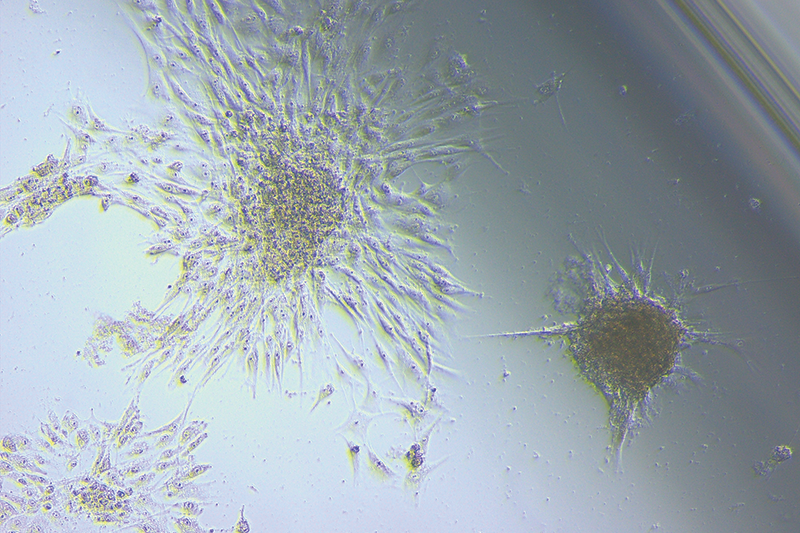
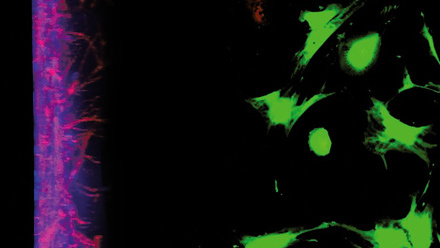
Representative microscopy image shows organised mesenchymal stem cell aggregation and cellular extensions on a defined biomimetic substrate of synthetic polymer. The controlled presentation of ligands at the material interface promotes collective cell behaviour and tissue-like morphology
© Tissue Click LtdPopulation ageing and the increasing demand for long-term implantable devices continue to intensify the need for innovation in the field of medical implants and regenerative medicine.
Biomaterials are central to these medical devices, including cardiovascular, ocular and orthopaedic implants, and wound dressings. Integration into surrounding tissue is governed by the controlled interaction of inflammatory cells and resident tissue cells with the implant surface, ultimately determining whether new tissue repair occurs at the implant-tissue interface.
Many scientists have responded to this issue through the development of biomimetic biomaterials.
In the UK, Professor Dennis Chapman – who founded Biocompatibles International plc in 1984 – studied the physicochemical properties of the surface of red blood cells. The aim was to identify the chemical moiety in the cell membrane that inhibits blood clot formation – phosphatidylcholine phospholipid.
This knowledge inspired him to develop phosphorylcholine-based polymers that were commercialised by Biocompatibles Ltd. These polymers were initially used to produce contact lenses and later coatings on cardiovascular stents.
Likewise, faced by the lack of integration of metal hip implants in orthopedics, the surgeon Ronald Furlong developed a coating system based on hydroxyapatite to promote osseointegration. The cementless prosthesis is timeless and often the technology of choice for hip implants, especially in young patients whose bones can actively regenerate at the surface of this host tissue-mimicking biomaterial.
Similarly, Professor William Bonfield recognised that although hydroxyapatite is osteoconductive, it is mechanically brittle. By combining it with a polymer matrix, he developed composite materials with improved mechanical compatibility for load-bearing and implantable applications.
The legacy of these visionary scientists is not given its due prominence, including the knowledge and experience in biomimetic biomaterials that has since been passed onto new generations of scientists.
At the University of Brighton, UK, this legacy is well remembered and being taken forward.
Since the early 1990s and under the leadership of Professors Stephen Denyer, Andrew Lloyd and Matteo Santin, this research group, now named the Centre for Regenerative Medicine and Devices, has focused on biomimetic biomaterials at the nanoscale. The shift towards the nanoscale marked a significant refinement of biomimetic thinking.
As the understanding of cell-material interactions deepened, it became increasingly evident that biological responses are governed not only by the bulk composition of an implant of surface chemistry, but by the spatial organisation of functional groups at the nanoscale level. Protein adsorption, receptor clustering and intracellular signalling pathways are influenced by ligand density, orientation and distribution across a material interface.
In this context, biomimetics evolved from reproducing the chemical identity of tissues to engineering the architecture through which cells perceive and respond to synthetic materials. The interface itself became the principal design space. Controlling molecular presentation with precision offers the possibility of directing cell behaviour in a more predictable and tuneable manner.
Translating such nanoscale control beyond the academic laboratory has required a dedicated space capable of sustaining technological development, protecting intellectual property and navigating commercial pathways. It was within this scientific and translational landscape that Tissue Click Ltd was established.
Click through
Tissue Click was founded in December 2011 by Santin, with the mission of translating nanoscale biomimetic surface engineering into commercially viable technologies.
From its inception, Tissue Click was structured around three interconnected pillars – the development of biomimetic biomaterials at the nanoscale; the application of technopreneurship as a means of transforming scientific knowledge into economic and societal value; and, finally, continuing the UK’s legacy in translational biomaterials research.
Technopreneurship at Tissue Click was not conceived in the conventional venture capital sense but as a model of 'sustained technology maturation'. The company sought to capitalise on accumulated scientific expertise while advancing the technology through competitive public funding, strategic partnerships and validation at different stages.
Tissue Click flagship is a range of synthetic polymeric biomaterials that simulate specific components of the extracellular matrix (ECM) of tissues, both in their biochemistry and nanotopography (or nanoroughness). These substrates seek to control tissue cell behaviour at two different levels:
A. The ability to engage with specific receptors at the cell surface and regulate their distance within the cell membrane and specific intracellular pathways. This is obtained by presenting to the cell’s specific, short, linear, peptide sequences (or other relevant functional groups) in a space- and density-ordered manner through the terminal ends of multi-branched peptides.
B. The consequent response of the cells that, in these conditions, have an enhanced ability to communicate with each other and come together to form tissue-like structures.
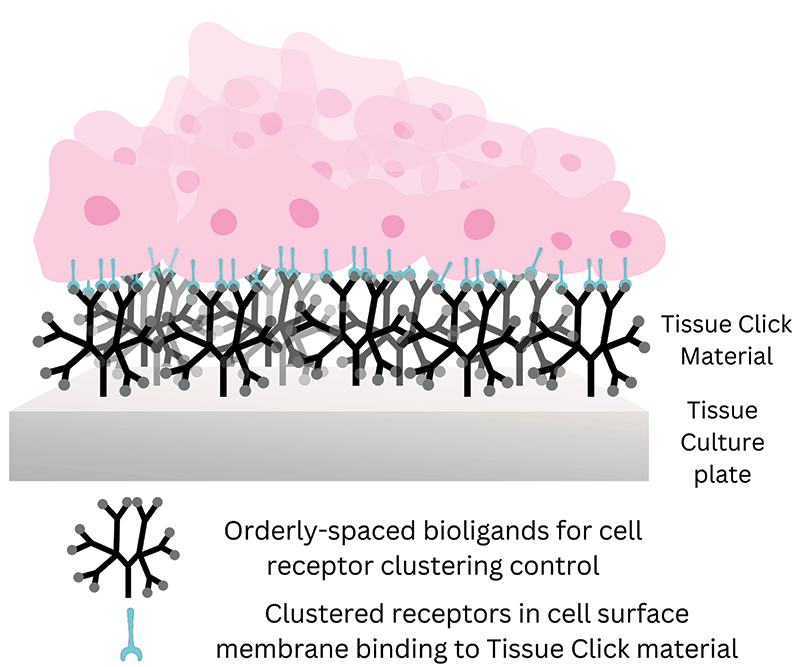
Schematic representation of multi-branched macromolecular architectures presenting bioactive ligands at controlled spatial densities on a tissue culture plate. The defined organisation of ligands enables receptor clustering at the cell membrane and modulation of downstream signalling pathways
© Tissue Click LtdCurrently, these products are commercialised as cell substrates to be used in vitro by cell biologists focusing their research on cell organotypic cultures, spheroids and organoids – the new frontier in the discovery of cell biology, new drugs and regenerative medicine therapeutics.
These biomaterials offer several advantages like recombinant proteins (e.g., laminin, fibronectin), collagen or collagen-based biomaterials (Matrigel, gelatine), and polysaccharides (e.g., alginate).
In fact, they can be provided to scientists with bioligands specific for the type of cells (cell phenotypes) they are working with. When used as the coating of conventional tissue culture plates for cell culture, they form an invisible molecular layer that does not alter the quality of the microscopy.
Allowing the formation of tissue-like structures on a 2D plane, these biomaterials facilitate characterisation of cells by molecular biology techniques as they eliminate the need to embed cells in a 3D scaffold or a gel, and the consequent need to liberate them from the support at the end of the experiments.
In a different approach, data show that very low concentrations of these substrates can be dissolved in the conventional tissue culture media to favour ordered aggregation of cells in microgravity conditions. In vivo tests show excellent tissue regeneration processes in orthopaedic applications paving the way towards an expansion of the business into the biomedical market.
An alternative business model
There are many definitions for technopreneurship, a term mainly used in relation to the IT field. We use the portmanteau as a means to transform science-informed technology into economic and human capital through commercial exploitation and training.
At the time of its inception, a clear vision was set for Tissue Click. There was no immediate urgency to go out in search of investors. The conviction was that years of work to build knowledge in the field of biomimetic biomaterials could be considered an investment on which it was now time to capitalise.
We were equally clear that the company vision was to return to communities the investment from the public. With this ethos at the company’s heart, we patiently began to bid for public funding through Innovate UK and European Commission calls for proposals.
From 2011 onwards, we secured grants of increasing value, enabling the company to first hire a space in the laboratory facilities of the University of Brighton and employ a researcher, and later to establish its own facilities in incubators and grow its personnel.
More importantly, Tissue Click succeeded in its grant pursuit by entering strategic partnerships with research organisations in the UK and across Europe.
In each case, the start-up protected the background confidential know-how, while benefitting from the expertise, facilities and budget investment of the project partners in testing and validating its technology. This approach has proven invaluable in developing a body of data collected by independent experts with state-of-the-art facilities and methodologies. This boosted confidence in and the economic value of the biomimetic biomaterial platform.
Certainly, this approach is a ‘low burner’ compared to the most common model of business angels and investors being involved while developing and validating technology at different stages towards exploitation.
However, this alternative model means the company has had the freedom to dictate its direction of travel and could put in place the building blocks to ensure its products are of significant benefit to the health of citizens – who, through public funding, were our early investors.
Even so, Tissue Click does not deny the importance of private investment. It has been fine-tuning the technology to the point that it is mature enough for comprehensive validation for clinical applications.
Since May 2025, this process has been initiated and negotiations with other parties are in progress.
Training ground
Beyond technology development, Tissue Click has functioned as a training ground for early-career scientists working at the interface of materials science and regenerative medicine.
Since its foundation, the company has primarily recruited University of Brighton graduates, from undergraduate and postgraduate students, as well as ex-research fellows, providing exposure to intellectual property strategy, regulatory considerations and industrial manufacturing constraints.
These early-career researchers learn how to set strategies to solve potential manufacturing constraints, such as purity and cost-effectiveness upon scaling up, packaging contamination and sterilisation processes.
For many people, the company has represented a bridge between academic biomaterials research and broader professional pathways. Staff who have left Tissue Click have progressed into roles in other biomedical companies, patent law and advanced PhD programmes, contributing to a wider ecosystem of expertise in materials innovation. This circulation of talent reflects a broader objective – sustaining national capability in biomimetic biomaterials science.
The development of advances in biomedical technologies depends not only on molecular design and surface engineering, but on maintaining a skilled workforce capable of navigating both scientific and commercial landscapes.
In this sense, Tissue Click’s contribution extends beyond its material platforms to the cultivation of the next generation of scientists operating at the boundary of research application.
At the interface
Sixteen years later, Tissue Click represents one stage of a scientific trajectory that began decades earlier. The pioneers of biomimetic materials demonstrated that replicating biologically relevant chemistry and composition could transform implant performance.
Phosphorylcholine polymers reduced thrombogenicity, hydroxyapatite coatings promoted osseointegration and composite systems improved mechanical compatibility. These advances established a guiding principle – material design must account for biological response at the interface.
The shift towards nanoscale control did not replace this principle but refined it. As understanding of cell-surface interactions deepened over the years, attention turned to molecular presentation, spatial organisation and receptor engagement. It is within this context that Tissue Click has sought to extend thinking around biomimetic biomaterials, focusing on the controlled display of functional motifs through defined macromolecular architectures.
In parallel, Tissue Click’s technopreneurship approach aims to preserve the intellectual and interdisciplinary approaches that characterised earlier generations of UK biomaterials research. In this sense, the company has positioned itself as both beneficiary and custodian of that legacy.
The next chapter of biomimetic biomaterials science will depend not only on further technology refinement, but on maintaining the framework that links chemistry, materials science and cell biology. Extending biomimetic design to even finer scales of molecular control remains both the challenge and the opportunity.