Flying the flag
The Red Arrows blaze a trail with a new approach to fuelling propulsion and producing their distinctive vapour trails

Witnessing the roar of nine jets in perfect formation over Buckingham Palace in London, carving the colours of the Union Flag into a summer sky, is an iconic British sight.
In most people, the spectacle evokes national pride and awe at the precision flying and elite performance. But behind this aeronautic display, a question looms – can a world-famous aerobatic team keep thrilling crowds while reducing its environmental impact?
In 2025, the Royal Air Force (RAF) Aerobatic Team, better known as the Red Arrows, approached this challenge head on.
The ‘Green Arrows’ concept is not new. Media interest and studies span at least a decade, but previous work only delivered light-touch recommendations – undone by the familiar constraints of funding, time, capacity and specialist technical depth.
Setting the challenge of turning talk into reality, with little to no extra funding or headcount, and in less than six-months, Project VIRIDIOS was established internally in December 2024. The project had one clear objective – to enable fully or partially sustainable flypasts and aerobatic display options for the 2025 display season.
With a fleet of 50-year-old Hawk T1 aircraft, no new technology and without the chequebook normally assigned to such initiatives, they set out to prove that sustainability is not a distant dream – it is a choice.
On 14 June 2025, the Red Arrows completed a flypast for His Majesty (HM) King Charles III’s Official Birthday, following the Trooping the Colour. The planes used a 39% blend of sustainable aviation fuel (SAF) to power their single Adour jet engines, and hydrotreated vegetable oil (HVO) to produce their trademark red, white and blue vapour trails. This was a world-first use of SAF for any formation of aircraft and of HVO in this application.
The approach was repeated throughout the team’s 2025 Display Season, including another first in an aerobatic team display at the Royal International Air Tattoo (RIAT). Further demonstrations were present at the F1 British Grand Prix, International Ayr Show and the Great North Run.
At a critical time, when the UK aspires to lead in sustainable fuels, strengthen NATO-aligned energy security, and inspire and attract increasingly climate-conscious future engineers, there are few stages that offer the same public profile as nine aircraft soaring down the Mall in London or over the start line at Silverstone racetrack. Sustainability in aviation had become a headline act – visible, measurable and impossible to ignore.
The timing is key, as public scrutiny has also grown, with airshows increasingly focused on reducing their carbon footprint. There is naturally more ‘attention per emission’ than in other transport sectors, despite estimates equating the Red Arrows’ total annual display emissions to 4% of a single day’s UK road emissions and less than two days of typical Heathrow-JFK traffic.
Full throttle
The propulsion strategy was deliberately conservative – to use certified, drop-in SAF and stay within existing defence standards. With UK Defence purposefully aligned to ASTM International standards, this means a maximum blend of 50% SAF was the ceiling of the project’s envelope.
Although higher‑blend options were explored, it quickly became clear that pursuing them would compromise the intended schedule, require extensive testing and potentially impact long‑term airworthiness. Amidst a backdrop of challenges with ageing engines, this was not deemed necessary or acceptable.
Yet even a standard rulebook is not a throttle in a pilot’s hand. It is imperative to understand that not only do the Red Arrows fly in incredibly close formation, with wing-to-wing separation as little as 1.2m, this spacing is maintained through positional references to the Team Leader and intermediate aircraft, responding to audio cues.
Ultimately, only one of the nine pilots – Red 1 – is focusing on navigation, altitude and angles during a display. The pilots are highly experienced and train extensively for this, but the demands reframe the risk considerably – thrust, response and reliability are non-negotiable in manoeuvres. Any change in response or recovery at under 1,000ft, during a loop or a roll, can escalate from critical to catastrophic in milliseconds.
Trust in the project’s approach was established initially through conversations with the Typhoon Display Team, which had operated with SAF under similar conditions, albeit as a singleton, at RIAT 2024. They reported no detectable performance change to the pilot. Even so, with two engines, significantly more thrust, and advanced engine management systems, the comparison was imperfect. Unlike the Typhoon, the 50-year-old Hawk offers no redundancy, and a single loss of thrust in close formation is unforgiving.
This nervousness was eased with an initial, single-aircraft assessment in a simplified profile. This was followed by a single-aircraft assessment within formation flown by the Team Leader, selected due to their increased situational awareness of speed, height and position.
These successes supported the theory that SAF blends behaved transparently for an operator compared to traditional fuels, even under the unique demands of Red Arrows formation flying. As a result, a 39% SAF blend was used for HM The King’s birthday flypast, and subsequent operations used blends of 35%, 30% and 10%, depending on availability and budget.
Did you know?
Since its inception in 1964, the Red Arrows’ motto has been ‘Éclat’ – meaning brilliance. The team exists to represent and showcase the excellence of the Royal Air Force. Its profile and other three functions – to support UK industry, facilitate international engagement and promote recruitment – make the Red Arrows a uniquely visible platform for demonstrating innovation across defence and aerospace, both at home and overseas.
Blazing a trail
While SAF integration was largely a matter of validation, transforming the smoke system posed a far more complex challenge. The cleaner answer was also the harder one. There was no evidence base, no certification pathway and little to no historic documentation.
However, the absence of evidence also proved the catalyst for progress, as there was little historic documentation around the traditional use of road diesel to generate the iconic vapour. There was scant in the way of approval or prohibition in the data.
Indeed, to deliver on the basic theory of generating a vapour cloud from the exhaust, almost any flammable liquid can be used. But, critically, a replacement has to integrate with the air system without modification, maintain smoke performance and colour, and be interoperable with both the existing dyes and diesel.
These requirements formed a clear matrix for testing and integration. A pathway to exploit rising confidence in HVO emerged, by combining initial research from the VIRIDOS team, a previous study in 2021 and evidence from the RAF’s Project ESTER.
The latter trialled alternatives for use in the No.2 Mechanical Transport and No.3 Mobile Catering Squadron. The team was able to salvage a 66% blend from ESTER and a small sample of pure HVO, providing immediate feedstock for bay-testing compatibility with the smoke generation system.
The team developed a four-phase qualification route:
- Static bay testing for compatibility with system materials, diesel and dye
- Desktop literature review supporting safety and
- interaction reports
- ‘Blind’ air assessment (white only, no dye)
- Full air assessment
By late January 2025, all hopes were pinned on success with HVO. Initial tests started in the team’s Dye Bay at RAF Waddington, starting with seal immersion in fuels and dye mixes. Three different functional nitrile-butadiene-rubber seals and one sealant sample were immersed in structured diesel-HVO ratios, with and without dye, for 28 days.
The purpose of these tests was to measure the swell, tensile, softening, visual and mass variations.
Parallel tests measured phase separation, solidification, crystallisation and colour degradation for the same period, again in structured ratios. The results suggested higher HVO proportions reduce seal expansion, potentially increasing their longevity, as the system is not reliant on their expansion.
Safety (SAR) and integration (IAR) assessment reports followed, drawing on immersion and stability test results and other sources. The SAR examined hazards and potential threats associated with airworthiness as well as flight safety risks.
The IAR specifically evaluated and mapped the likely impacts to these risks based on 15 attributes of HVO, including environmental health, fire and explosion, flash point, cetane value, cold (high-altitude) performance, microbial resistance and more.
Crucially, alignment with BS EN590 means HVO shares a certification lineage with existing diesel, removing a major barrier to operational adoption.
Added benefits are its biodegradability and odourless qualities with regards to air quality in crowds and the local area. The conclusion was that HVO was safe to operate, though subtle cetane value differences might affect performance. A recommendation for limited flight assessment was accepted.
On the runway
Competing priorities delayed the UK air assessment, but what proved invaluable was the foresight in pre‑positioning the remaining HVO‑diesel stock at the team’s spring training camp in Greece. The clock was ticking at this stage, with the initial quote for ordering HVO within the timeline being eaten into and no air-validated success yet demonstrated.
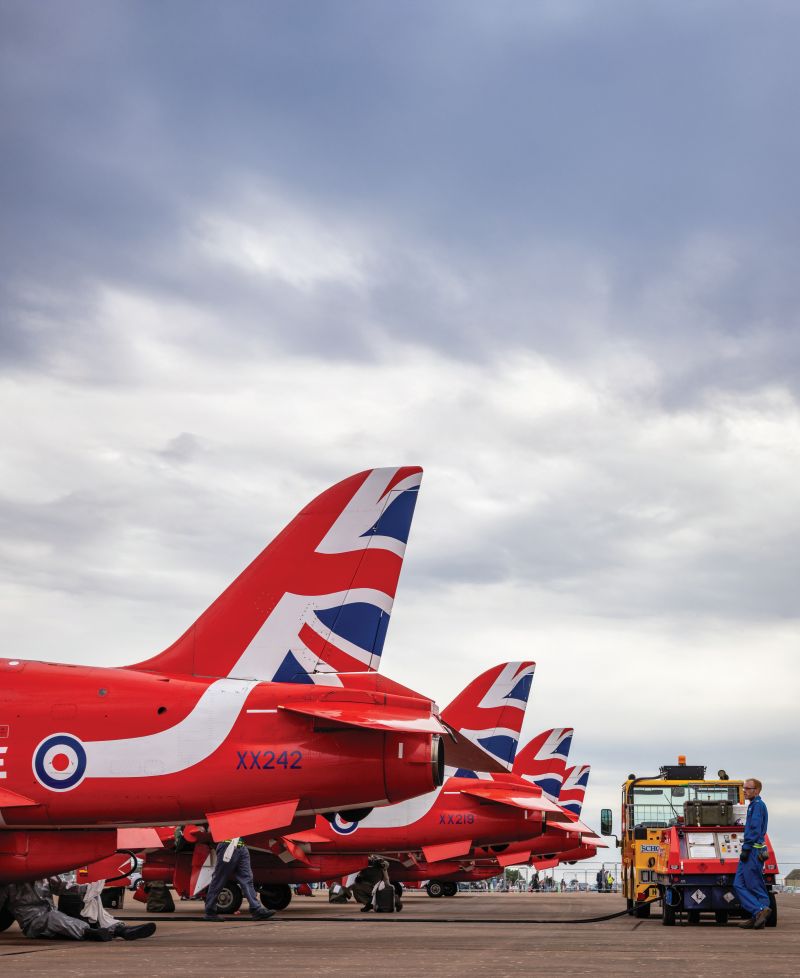
An experienced panel was brought together, including the team supervisor, PR manager and long-term Chief of Staff. On the day of the air assessment, 2 May 2025, they were positioned at the display datum – the geographic point around which the team centres any given show. The panel were not informed which aircraft was loaded with HVO and were requested to feed back their observations.
Further to the display, a flypast was carried out over the main operating airfield, with a similar panel of engineers assembled. The results were almost perfectly scattered. No observer correctly identified the HVO-loaded aircraft, and the majority misidentified its neighbour, Red 7.
With the findings submitted to two independent chemistry professionals to assess the work and evaluate whether the interaction with the dye under heat would likely present any explosive or unsafe conditions, the team arrived back in the UK to the receipt of a bulk order of 100% HVO.
Concurrent with progression of the technical work, it was equally important to ensure that the innovation could be delivered. The logistics would ultimately determine whether the ambition could become an operational reality.
To achieve a credible high-SAF blend for the flypast, fuel had to be delivered directly by road. Although a ready-to-go 39% stock at RAF Northolt was identified, contracting this movement would be expensive and sourcing a road-legal and available military tanker, alongside national operational commitments, presented its own difficulty.
Similar challenges arose with the delivery of HVO. The ESTER project stocks were exhausted, nor 100% pure. So, shortly after the air assessment in Greece, an order was made on-risk.
Replenishing the smoke pod also requires a specialist adaptor, unique to only three RAF diesel trucks, and it was not yet approved for HVO carriage in their tank. Overcoming this required a usage exemption from the vehicle sponsor based on the ESTER trials.
When the moment came, both fuels were barely in place, but ready. On 13 June, less than 24 hours ahead of the flypast, armed with all qualification evidence, four aircraft were loaded with varied, white-only, colour-only and mixed configurations. Once again, observers were unaware which aircraft were loaded with HVO, as a final confidence check ahead of the world-first demonstration over Buckingham Palace the following day.
In the spotlight
The late qualification of the HVO and 11th-hour acquisition of a SAF bowser meant media deadlines were behind track and, after 10 years of talk, it was difficult to instil confidence in delivery before June. However, the team was able to build trust with a small group of influential stakeholders, while managing expectations of technical uncertainties. HVO for white looked achievable from early on, but SAF and colour remained aspirational.
The BBC, as media lead for the Trooping the Colour event, took significant interest, which added pressure and opportunity. The high-profile attention helped accelerate decision-making during latter stages, while increased exposure amplified the project’s reach.
Misunderstanding to momentum
Sustainability is expensive, which will always complicate adoption. Beyond this obstacle, the Reds’ journey faced misconceptions, myths and misinformation throughout.
HVO is the true star of the initiative – a total world-first, demonstrating the objectives of internal innovation and rapid capability development. Yet it was SAF that always dominated the conversation. Likewise, emissions reduction frequently took centre stage, despite the more strategically important benefits to national energy security and operational resilience.
Ensuring correct messaging proved more difficult than first expected. It was important to clarify that the HVO did not power the aircraft, SAF is not experimental, the vapour would not smell of chips, and that reducing emissions were not the sole headline benefit. Careful stewardship of the narrative was managed by the team’s PR manager, ensuring public understanding and internal support.
Social media added its own layer of noise, with comments on ‘chalky’ smoke and imagined chip‑shop aromas, even at displays where HVO was not used. In reality, the HVO increased colour brightness, was scent-free and environmentally cleaner.
Despite these distractions, Project VIRIDIOS was an undeniable success. It delivered on an ambitious six-month timeline, generated significant engagement in sustainable aviation conversations and received overwhelming public support.
The team intends to leverage this momentum to continue engaging diverse audiences. Education is a key pillar, inspiring the next generation of engineers and aviators, demystifying sustainable energy, and highlighting both the inherent opportunities and challenges.
Education is equally vital within defence and industry. There are countless lessons to be shared, including evidence of sustained interoperability with traditional fuels in Ministry of Defence vehicles.
Project VIRIDIOS was deliberately insular to accelerate delivery, but benefitted from the combined engineering, logistics and media expertise embedded in the team. Going forward, collaboration is imperative for identifying more efficient and cost-effective methods of increasing our national and operational resilience.
Perhaps though, the most meaningful lesson is cultural. Specifically, that passion and perseverance matter.
For 60 years, the Red Arrows have embodied precision, teamwork and excellence. Today, the team shows that those qualities apply as much to engineering innovation as to aerial displays.
Without new aircraft, new technology or dedicated resources, the team proved that meaningful progress is possible without substantial costs or extended timelines. The formations, thrill and spectacle are unchanged – but the thinking, and the fuel behind them, is already transformed.
Operating a 50-year-old aircraft, with a legacy engine and smoke-generation system, did not preclude meaningful change. It simply demanded creativity, a pragmatic approach and the courage to start with what already exists. Better, the work is not complete and nor should it be. Where can we partner? What more can we do?