Flash sintering sodium-ion batteries
Flash sintering technology can reportedly manufacture sodium-ion battery materials faster and more sustainably.
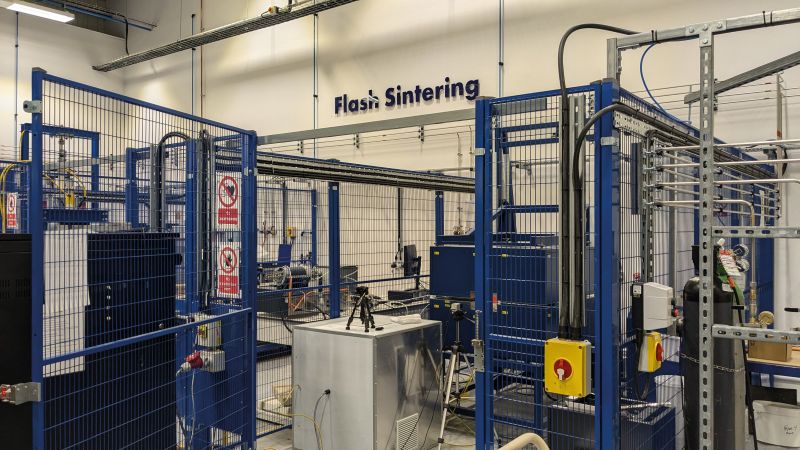
A 78% energy saving is reported in manufacturing a cathode material through flash sintering, according to a consortium led by Batri Limited, including Lucideon and Swansea University, UK
Flash sintering applies an electric field to a material via customised electrodes to deliver a concise, high-temperature heating rate accurately. It is used mostly to rapidly sinter ceramic materials, with Lucideon developing real-time control systems.
Here, the team produced a conventional cathode from NMO – sodium layered manganese oxide – powder, which was pelletised before sintering.
Different electrodes/interfaces have been trialled in the project, and the current was progressively increased via the voltage. The peak voltage was typically less than 40V, while peak current varied between experiments and depended on process parameters and pellet size.
The 10mm-diameter, 4mm-tall pellets, weighing 0.65g were scaled up in stacks of multiple pellets of up to 2g of material, to be processed in one electrode set-up.
Larger pellets of 20mm diameter, and almost double the thickness and height, allowed up to 5.5g to be processed.
The 10mm pellets had a peak current of up to 10A, while the larger pellets had a peak current of 40A.
Lucideon say flash sintering reduces the energy needed, with heat more directly targeted.
As a result, the cathode material was manufactured in a furnace at 600°C with a cycle time of around 30 minutes to two hours. The group says conventional synthesis occurs at 850°C with a 10-hour dwell cycle.
This reportedly validates the feasibility of using a flash sintering method for layered, oxide, battery cathode production, which can be applied to other battery materials.
Dr Gareth Jones MIMMM, Lucideon’s Flash Sintering Technical Lead, explains, 'Material was able to be manufactured in furnace temperatures several hundred degrees Celsius lower than standard processing, leading to 80% reductions in cycle time and process energy consumption.
'And as we scaled-up the process, we were able to significantly increase the amount of powder processed in one run.'
The stacked 10mm pellets increase voltage requirements but maintain current and have a better conversion rate, which the team thinks might be due to the additional pellets reducing loss of volatiles. Lucideon highlights that, conventionally, outer pellets in a stack are often sacrificial, but their technique processes all the pellets.
While the larger pellet size meant the required phase of the material was easily obtained, they struggled to get a high percentage yield of the desired product. Also, there were different by-products, which might be due to temperature variation or inhomogeneities in the current across the sample.
There were also some differences observed between the material produced by flash sintering compared to conventional methods.
The pellets produced by flash sintering are reportedly harder to grind to turn into battery cathodes, thought to be due their increased density. There are also some differences in rheology, attributable to the particle size of the ground powder, and in the charging characteristics of the battery cathodes.
The battery cathodes produced from flash-sintered material have a comparable first-cycle capacity to conventionally synthesised NMO, the team finds, at 2-3.95V compared to 2.5-3.95V. However, a small instability in cycle capacitance has been observed for all flash-sintered cathodes. The consortium says this could be from impurities or unreacted precursors but can be improved.
They now aim to fine tune the process for more energy savings and to increase the volumes of powder to tens of grammes per sample pellet, before progressing to hundreds of grammes. To be commercially viable, the team notes the need for greater scale.
Lucideon say the pilot 'could be an ideal process for forming a solid ceramic battery electrode, as it performs the material synthesis and sintering in one step'.
The 12-month feasibility project has been supported by UK Research and Innovation’s £318mln Faraday Battery Challenge fund.