Earth’s digital twin to improve AI climate predictions
The third phase of this European Commission initiative has been agreed.
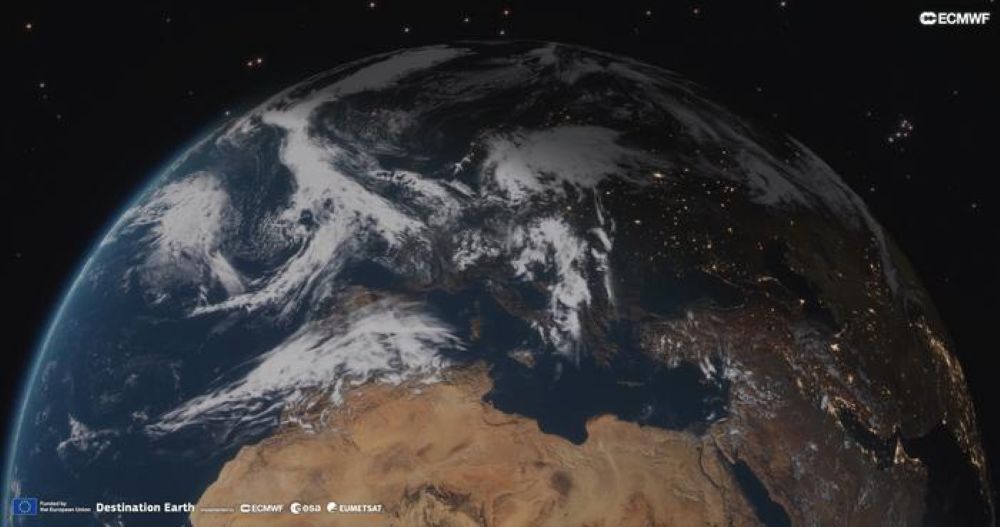
The European Commission and the European Centre for Medium-Range Weather Forecasts (ECMWF) Destination Earth (DestinE) digital twins enable exploration of past, present and likely future climate and extreme conditions.
The third phase will start in June 2026 and end in June 2028.
These help European and national institutions understand and better prepare for risks caused by extreme weather and climate change.
Roberto Viola, Director-General of the DG for Communications Networks, Content and Technology, European Commission, says, ‘Destination Earth demonstrates how Europe can transform major investments in supercomputing and artificial intelligence into concrete benefits for its citizens. By uniting world-class EuroHPC infrastructure, cutting-edge AI Factories, and Europe's unparalleled expertise in climate and weather science, DestinE strengthens our collective capability to anticipate climate and weather threats — and to act decisively on them.’
Since 2022, ECMWF has worked closely with ESA, EUMETSAT and more than 100 partner organisations, including many national meteorological services, to implement the Climate Change Adaptation Digital Twin and the Weather-Induced Extremes Digital Twin.
These core components of DestinE have already progressed from early prototypes to modelling frameworks that routinely produce high-resolution climate projections and detailed simulations of extreme events.
Since 2024 (Phase 2), DestinE has also seen a substantial expansion of artificial intelligence (AI) activities, including the development of machine-learning components for different parts of the Earth system (land, ocean, sea ice, waves and hydrology), and AI-based solutions that enhance interactivity with digital twin data.
In Phase 3, ECMWF and its partners will focus on operating and interlinking the Climate and Extremes Digital Twins, and the Digital Twin Engine, and developing the AI capabilities further.
The developments include advancing and coupling machine learning-based Earth system components towards an AI Earth system model that complements physics-based simulations and supports uncertainty quantification and rapid ‘what-if’ experimentation.
It also includes producing high quality, AI-ready datasets that can feed Europe’s AI Factories, strengthening links between supercomputing, AI and Earth-system science.