Shining a light on agricultural chemicals
Organic light-emitting diode (OLED) materials have potential for pesticide detection.
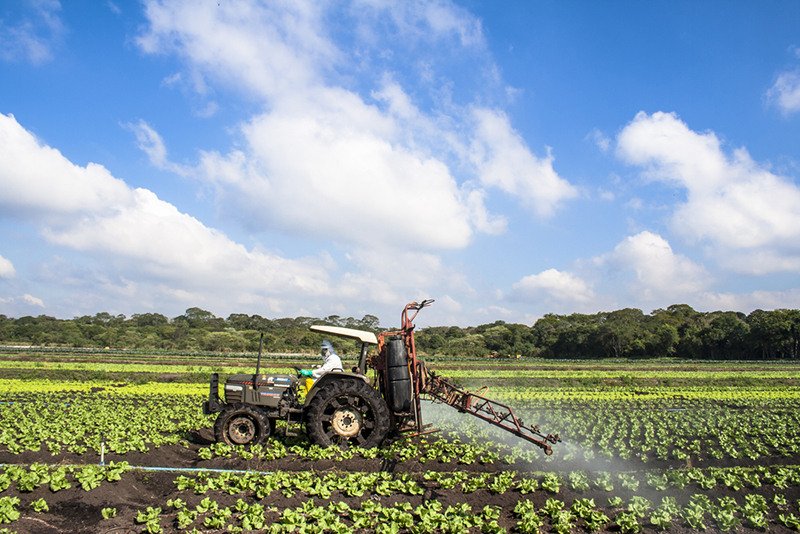
A £200,000 grant from the Royal Society will bring together materials and environmental contaminant detection researchers to assess the scale and impact of these chemicals in the Brazilian agricultural industry.
Brazil is one of the world’s largest producers and exporters of agricultural products, such as coffee, sugar, tobacco, citrus fruits and grains, but relies heavily on pesticides and herbicides in farming with more than 720,000t of pesticide ingredients sold in 2021, leading to high levels of chemical contamination in the produce grown.
Researchers from Northumbria University, UK, and the Federal University of Santa Catarina, Brazil, will develop sensors made from OLED materials that will respond when they interact with pesticides, by glowing, stopping glowing, or changing colour, making it easier to detect their presence on crops.
Aggregation-induced emission, when materials immediately get brighter, and aggregation-induced delayed fluorescence where the materials emit light at a delayed timescale will feature.
Dr Marc Etherington, an Assistant Professor in Molecular Photophysics at Northumbria University, has recently been investigating the light-emitting, light-absorbing and time-delay properties of fluorophores.
Using a specially developed spectrometer, he has been hopeful of finding new light-based solutions to real-world issues. He says, ‘If this study works in the way we hope, we believe the science behind it will be applicable for a wide range of industries. There is some huge potential from this work.’
The project will be supported by HORIBA, UK, which develops fluorescence spectrometers and sensors.
Dr Simon FitzGerald, Head of Science and Technology at HORIBA UK, adds, ‘We’re delighted to connect the project researchers with experienced HORIBA scientists in both the UK and Brazil to explore how the latest spectroscopic and imaging technologies can be applied. Technical exchange with the researchers will ensure the most effective use of the latest products and help translate data into meaningful insight.’
The Royal Society has granted the funding to the universities through its ISPF International Collaboration Awards, which supports developing countries. It will enable researchers to travel from Brazil to the UK to work with academic and industry partners, supporting knowledge exchange and skills development.