Self-assembling material closes the loop on EV batteries?
Electric vehicle (EV) batteries could become easier to recycle thanks to an electrolyte made from a new self-assembling material.
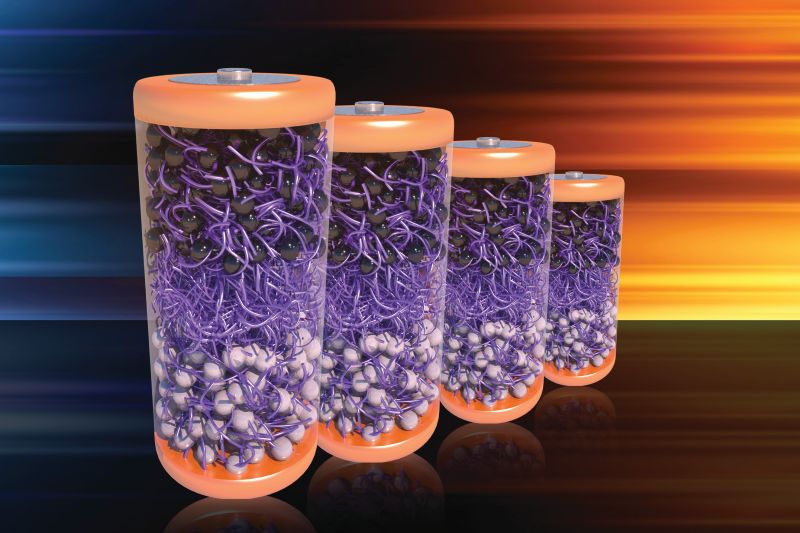
The material dissolves in organic solvents so that the individual parts of a solid-state battery cell can be recycled.
Once this proof-of-concept is demonstrated at a commercial scale, researchers at the Massachusetts Institute of Technology and Stanford University, USA, suggest it could remove the need for shredding end-of-life batteries into a fine powder, treating the ores, and applying chemicals and high-temperature treatment to recover critical metals.
They focus on fabricating easily recyclable materials for batteries from the start rather than designing high-performing, structurally complex batteries made from difficult-to-recycle materials. The main challenge is designing a new material for battery compatibility.
Yuko Cho, material chemist and Stanford University Energy Fellow, compares their self-assembling material to a mayonnaise filling in a sandwich layer.
'It’s incredibly difficult to recover individual components like lettuce, ham, or bread once a sandwich is fully glued, smashed and shredded. But if a mayo layer could help the ingredients stick together during operation – yet still peel apart easily afterward – that would be the dream.'
Similarly, an EV battery comprises three parts – the positively charged cathode, the negatively charged electrode and the electrolyte.
The researchers deployed aramid amphiphiles (AAs), a class of molecules with a chemical structure and stability similar to Kevlar that self-assemble in water. After polyethylene glycol (PEG) is injected into the AAs to enhance the electrolyte’s functionality, each molecule end conducts lithium ions.
Within five minutes of being dropped into water, the AAs are found to spontaneously assemble into millions of gel-like, entangled nanofibres that can be 'hot-pressed into a solid-state material'. Meanwhile, the ion-conducting PEG’s surfaces and bases demonstrate tight hydrogen bonding, creating a mechanically stable structure that conducts ions across its surface.
'The material is composed of two parts,' explains Cho. 'The first part is this flexible chain that gives us a nest, or host, for lithium ions to jump around. The second part is this strong organic material component that is used in Kevlar, which is a bulletproof material. Those make the whole structure stable.'
After constructing a solid-state battery cell using lithium iron phosphate for the cathode and lithium titanium oxide as the anode, they observed how the self-assembled material successfully shuttles ions between the electrodes.
However, during fast bouts of charging and discharging, the lithium ions’ movement from the nanofibres into the metal oxide was far less effective.
Cho admits that initially the team experienced shorting problems – the material is delicate and, unlike plastic, can’t be easily manipulated.
While further work to enhance battery performance is required, the electrolyte material offers great potential for recycling, says the team. Holding the two battery electrodes together, the electrolyte filling dissolves immediately in an organic solvent, enabling the team to recycle the electrodes separately.
Returning to the sandwich analogy, Cho suggests using the material with other components as part of the battery electrolyte layer – a bit like mayonnaise binding ham and lettuce between the bread slices.
'How we match up the battery performance with the current state-of-the-art [batteries] is definitely a key challenge,' he says. 'But with new battery materials that may come out in five or 10 years, it could be easier to integrate this into new designs in the beginning.'