Octopus-like flexible material changes colour and texture
The material can rapidly change surface texture and colour, potentially supporting camouflage, robotics, and bioengineering.
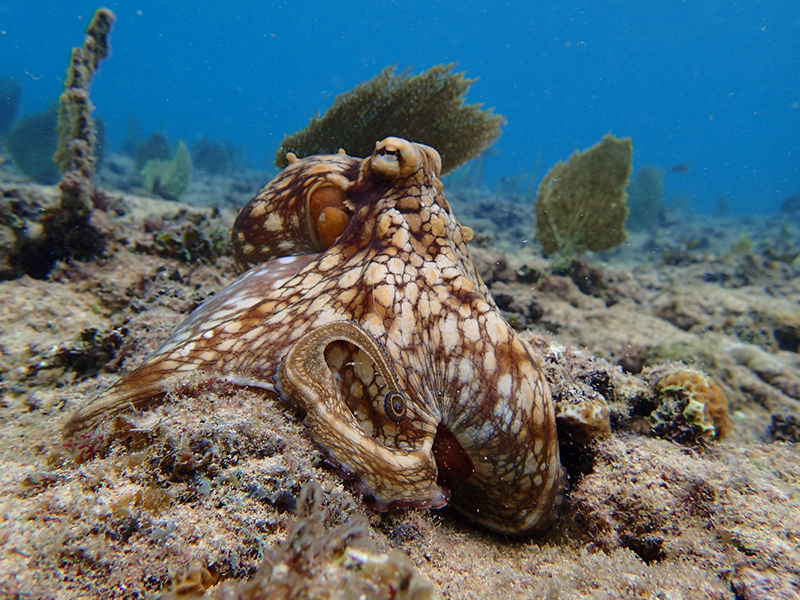
Stanford University engineers have developed a new flexible material that can swell into different textures and colours. They say this development could enhance synthetic materials to replicate the camouflage abilities of cephalopods.
In a paper published in Nature, the USA-based team say the work opens up new opportunities in the field of nanophotonics, which uses the precise manipulation of light and optics for advancements in electronics, encryption, biology, and other areas. To create dynamic textures in a flexible material, the researchers combined a patterning technique called electron-beam lithography, which is typically used in advanced semiconductor manufacturing, with a polymer film that swells as it absorbs water.
The discovery that an electron beam could change the polymer’s absorbency and create patterns of different colours and textures was surprising to the team who had originally used a scanning electron microscope – which uses a focused beam of electrons to create a high-resolution image – to examine nanostructures the team had created on top of a polymer film. Typically, those samples would be discarded after imaging, but Siddharth Doshi, a doctoral student in materials science and engineering and first author on the paper, decided to reuse them instead of creating new ones. In the next set of tests, the regions of the film that had been imaged with the electron scanning microscope behaved differently and turned a different colour.
‘We realised that we could use these electron beams to control topography at very fine scales,’ Doshi said. ‘It was definitely serendipitous.’
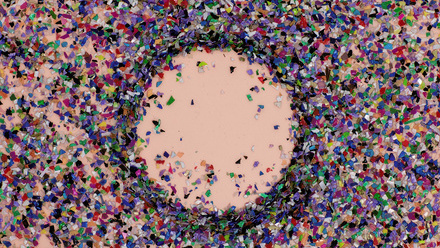
The team made fine-scale textures that change how light is scattered depending on the amount of water added to the film. This allows production of surface finishes ranging from glossy to matte, producing a more realistic appearance than smartphone or computer displays are currently capable of. All of the films are easily returned to their flat state by adding an alcohol-like solvent to remove the water.
They demonstrated that the same technique can be used to design and reveal complex, switchable colour patterns. They used thin, metallic layers on each side of the patterned polymer film to create Fabry-Pérot resonators, which isolate specific wavelengths of light based on the distance between the metal layers. As the polymer films swell to different widths, a variety of colours appear. With the same electron-beam patterning and the right mix of water and solvent, the single-coloured sheet becomes transformed.
Regarding next steps, the researchers hope to integrate a computer vision system, which would be able to automatically adjust the level of swelling.
‘We want to be able to control this with neural networks – basically an AI-based system – that could compare the skin and its background, then automatically modulate it to match in real time, without human intervention,’ Doshi said.
The researchers are also interested in applications beyond visual camouflage. Fine-scale changes in texture could be used to increase or decrease friction, which could help determine if a small robot will cling to a surface or slide past it. Nanoscale structures can change how cells respond, so there may be bioengineering uses for these techniques.