‘Natural, degradable polymer capsules’ for pharmaceuticals
Researchers in Japan claim they can convert naturally derived monomers into polymer capsules.
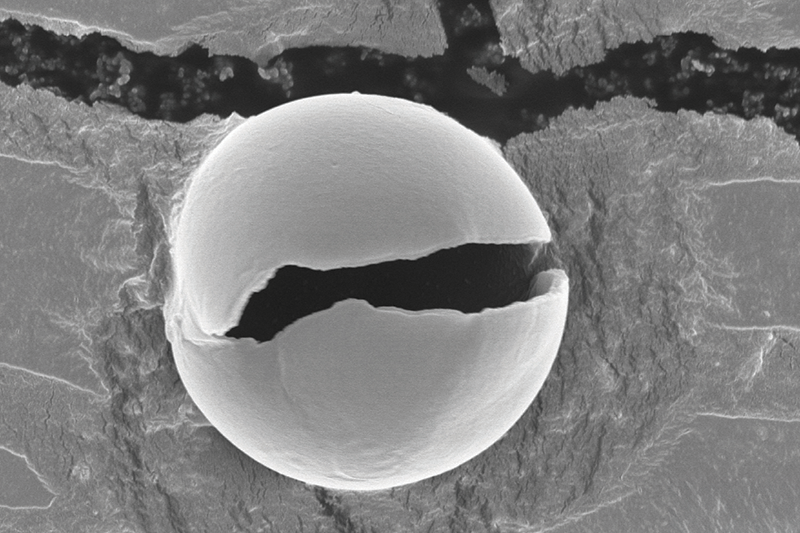
After being irradiated with light, bio-derived monomers become polymer capsules
© Osaka Metropolitan UniversityThey believe this will overcome the limitations of conventional capsules made of non-degradable polymers that store drugs and fragrances.
The Osaka Metropolitan University team reports to have demonstrated efficient encapsulation of fragrances in their materials and subsequent controlled release profiles.
The polymer capsules are synthesised from the bio-derived molecules glycerol, found in vegetable oil, and cinnamic acid, found in certain plants.
Associate Professor Yukiya Kitayama explains, 'We have developed a specific monomer architecture where these naturally occurring building blocks are connected via ester linkages, ensuring inherent biodegradability.
'The capsules are formed through a light-induced polymerisation of these monomers in an aqueous medium. Notably, this process is entirely additive-free, requiring no external initiators or catalysts, which ensures that the resulting polymer remains a 100% bio-derived and eco-friendly material.'
Kitayama claims, 'The primary advantage lies in the absolute chemical purity and biocompatibility of the capsules.' It “eliminates” the risk of leaching toxic residues into the environment or biological systems.
The capsules can undergo photodegradation upon exposure to short-wavelength light and can also be degraded by hydrolysing the ester bonds contained within the polymer.
'The material offers a controlled degradation pathway,' shares Kitayama. 'Upon exposure to environmental conditions, the ester linkages undergo hydrolysis, effectively reverting the polymer back into its original natural components.' This helps ensure the material does not contribute to microplastic persistence, assert the scientists.
They have found the naturally derived polymer capsules offer a year’s stable shelf life. 'This polymer capsule can stably encapsulate low-molecular-weight fluorescent dyes and fragrances. Furthermore, by expanding the synthesis scale to 100 times that of conventional methods, while maintaining process safety,' Kitayama says they have demonstrated its potential industrialisation.
Also, light inducement directly links production scale to the size and intensity of the light source. Kitayama explains, 'By increasing the irradiation area and using flow-reactor systems, the synthesis scale can be expanded proportionally.
'Furthermore, since the reaction occurs in water without the need for complex catalysts or high-pressure environments, the infrastructure required for scaling is relatively simple and cost-effective compared to traditional chemical synthesis.'
He suggests this can be applied across diverse fields, such as pharmaceuticals, cosmetics, fragrances and fertilisers.
Kitayama says the material is designed with economic viability in mind, based on two key factors – firstly, affordable raw materials that are abundant, naturally derived and cost-competitive compared to specialised synthetic monomers, and secondly simplified manufacturing.
'By eliminating the need for expensive catalysts, organic solvents and complex purification steps, we significantly reduce the overall processing costs and environmental overhead.'
This development was made possible through a technique honed by the team called ‘interfacial photocycloaddition polymerisation’.
Kitayama adds, 'This work builds upon our previous discovery that light irradiation on polymer particles with photoreactive side chains can induce a cross-linking reaction exclusively near the interface. By applying this ‘interfacial’ control to the polymerisation process itself, we have succeeded for the first time in creating 100% bio-derived capsules.'
Kitayama concludes, in future research, 'we are planning to adapt the current batch process into a continuous flow reaction system. This will improve production efficiency...We will [also] explore the compatibility of this interfacial photocycloaddition polymerisation with a wider range of natural molecules. By diversifying the building blocks, we aim to tune the physical properties of the capsules...to meet the specific requirements of various industries'.