Multilayer film enhances greenhouse efficiency
The multilayer film reflects heat while still letting in light to improve the energy and water efficiency of greenhouse agriculture.
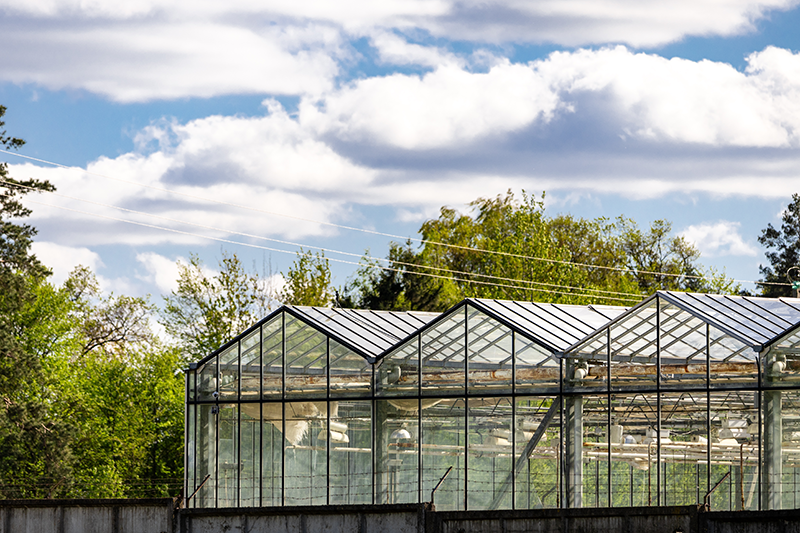
Greenhouses are useful for cultivating high yields of plants while conserving land, water and fertilisers. However, in hotter environments, temperatures can rise to levels damaging for crops, requiring cooling that is energy and water intensive.
In such cases, shade screening is common, but can block photosynthesis. A film patented by Amrit Thakur and Shamim Ahamed (Principal Investigator), from the University of California Davis, USA – dubbed ‘Cool-Cover’ – appears to overcome these issues.
The multilayer, photonic, thin film alternates six layers, each around 10-200nm thickness, of zinc oxide/calcium fluoride/silver/zinc oxide/calcium fluoride/zinc oxide.
Reportedly, the zinc-oxide layer (high index) provides phase control and durability, while the calcium-fluoride layer (low index) spaces the optical cavity. An ultrathin silver layer reflects near-infrared light (NIR), while imposing minimal loss in the plant-useful visible range.
The technology works by exploiting ‘thin-film interference in the dielectric layers and plasmonic reflection in [the silver layer]. The stack is tuned so that photosynthetically active radiation (PAR, 400-700nm) constructively transmits, while NIR (~700-2,500nm) is predominantly reflected’, share Postdoctoral researchers Thakur and Ahamed.
Lower NIR ingress reduces heat loads, cutting fan runtime/power consumption and evaporative-pad water usage.
They continue, ‘Because PAR transmission is high and angle-robust, photosynthesis is maintained or improved without the penalties of shade cloths/paint.’
The team used simulation software to optimise the film’s design and an established model of a standard greenhouse to predict how the film would perform in different environments with hot, dry summers and milder winters.
Thakur claims the results of the modelling show that their first-generation Cool-Cover cuts fan electricity consumption in a standard greenhouse by ~45-90% and evaporative-pad water usage by ~44-91%, while crop evapotranspiration fell ~36-66%. Adding, ‘despite lower total PAR, light-use efficiency rose ~60-75% (≈5 → 8-8.6g·mol-1), with yields generally within 0-17% of control depending on site/month.’
The film is applied by vacuum physical vapour deposition (e-beam or sputter) on clear polymer (PET) or glass. It can also be laminated on greenhouses on flexible PET as a retrofit with UV-stable adhesive and edge sealing. The same stack can be coated directly on glass in architectural tooling.
Thakur believes the advance will have implications for retrofit and new-builds in controlled environment agriculture/greenhouses and polytunnels, as well as glazing in buildings.
Thakur says the advance is coming to fruition now because the manufacturing and metrology technology have only recently matured.
Uniform, multilayer, physical vapour deposition on flexible substrates, durable topcoats and reliable optical property data now make it practical to build and verify the stacks at scale. Water and energy pressures in agriculture are the drivers.
The materials used are commodity thin-film consumables, and the coating can reportedly be batched produced and transitioned to roll-to-roll production, with laminated films sized for greenhouse bays and installed with standard glazing workflows.
Thakur and Ahamed’s team is forming a start-up to take the patented design to market and engaging potential investors/strategic partners to fund scale-up. They will run a pilot to pre-produce rolls for full optical and durability qualification and intend to laminate prototypes and conduct instrumented greenhouse bay trials.
Thakur is also hoping to push the design from ~50% PAR transmission towards >90% PAR, with production-tolerant recipes suitable for commercialisation with angle robustness.