Medical textiles that offer permeability and liquid repellence
Novel materials reportedly address the challenge of balancing protection and comfort in medical clothing.
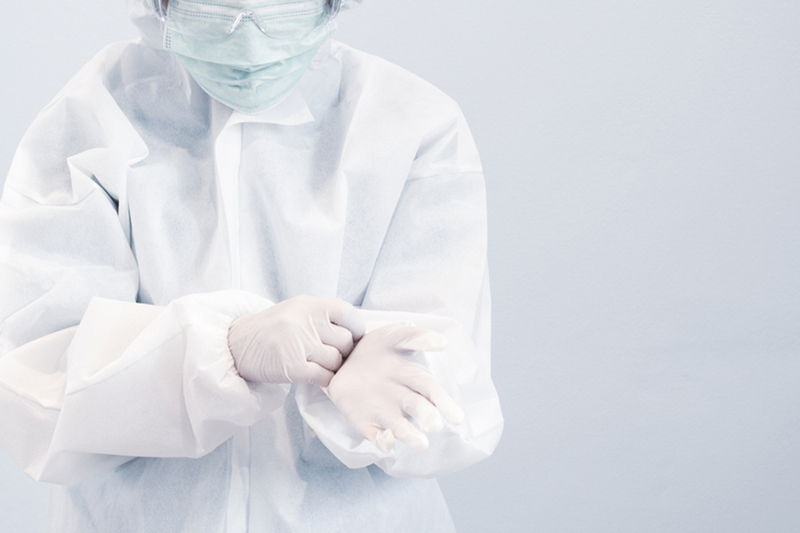
Researchers at Shanghai Jiao Tong University Journal Center, China, claim their highly permeable, liquid-repellent textiles (HPPT) materials offer 'superior air and moisture permeability, robust mechanical durability, and exceptional resistance to liquid penetration'.
The HPPT is fabricated using a non-solvent induced phase separation (NIPS) technique, synergistically driven by calcium chloride (CaCl2) and fluorinated polyurethane (FPU), followed by a three-proof finishing agent (TRG) spray to enhance surface hydrophobicity.
The optimised pore structure, with an average pore size of 1.03µm and high porosity (69%), facilitates air and moisture flow while blocking external liquid infiltration.
The HPPT achieves air permeability of 14.24mm/s and moisture permeability of 7.92 kg m⁻2 d-1, while maintaining a high hydrostatic pressure of 12.86 kPa even at elevated temperatures (up to 50 °C).
It reportedly displays strong repellency to water (WCA: 131°), blood (BCA: 126°), oil (OCA: 104°), and ethanol (ECA: 85°), maintaining these values over time and under dynamic conditions.
A tensile strength of 65.56MPa is reported and strong antibacterial performance due to the incorporated bacteriostatic components.
The textiles are said to maintain performance after 1,000 abrasion cycles and 100 washing cycles.