Managing materials
Digging into the reuse of below-ground products.
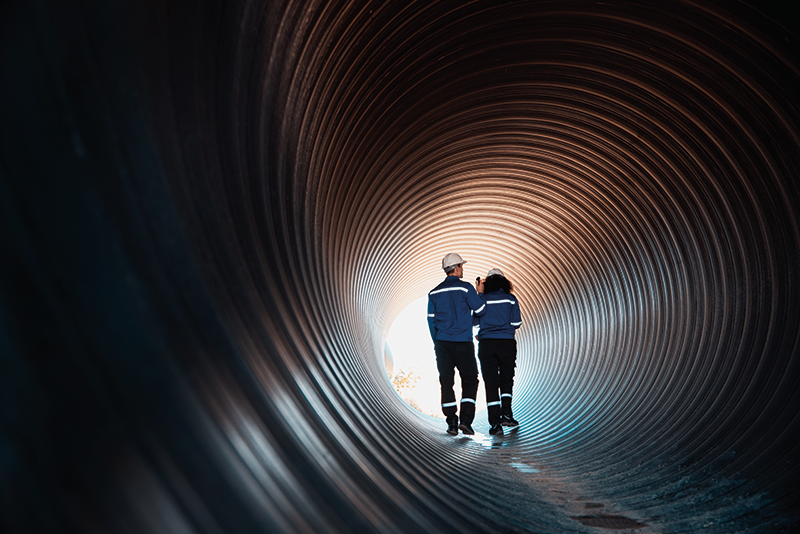
The concept of urban mining has become popular in the construction and ground engineering sectors to realise the potential value of reusing products and materials that make up our buildings and infrastructure in the pursuit of net-zero and a circular economy.
As part of the Reuse Now campaign, an initiative from The Alliance for Sustainable Building Products (ASBP), a webinar on ‘Exploring Reuse Opportunities – Below Ground Products and Materials’ tackled reuse of ground engineering products specifically.
Below-ground construction products and materials, foundations, piling systems and utility infrastructure (pipes and tubes) are essential to most structural projects. These elements are typically composed of high-volume, resource-intensive materials like concrete and steel. While their durability and integrity is paramount, their potential for reuse can be overlooked.
At the event, Andy Tyler, Senior Associate at Heyne Tillett Steel, discussed how the oil and gas industry generates thousands of tonnes of waste material with the potential to be repurposed, illustrating the possibilities for material reuse from underground sources.
Roy Fishwick, Managing Director at Cleveland Steel and Tubes, echoed this point, highlighting that over 500,000t of decommissioned oil pipes are available in Europe’s stock. He also noted that, as oil construction is bespoke, there are some irregular sizes of pipes that could be reclaimed and reused.
He cited the Browney Curve case study, a significant railway site in County Durham, UK. Here, a major £33mln project has been completed to stabilise an active landslide affecting the East Coast Main Line. The 5,000t material project repurposed over 3,500t of material, saving nearly 8,000t in carbon emissions.
Fishwick shared that reused material in this project was found at the same price or less to meet the client’s needs. And, in some cases, stronger material was used in place of alternative virgin stock at a lower cost.
Equally, in the Hunterston Turbine case study – a mega-turbine serving SSE’s Glasgow-based Centre of Engineering Excellence for Renewable Energy – it is reported more than a tonne of carbon emissions could be saved by reusing a tonne of steel versus virgin material.
Fishwick urged clients to dig deep and focus on the circular economy in relation to materials for foundations and other below-ground products.
Iain Bell, UK Sales and Purchasing Manager from John Lawrie Tubulars, has been repurposing steel pipes from the oil and gas sector for use in construction for years. Their stock is procured from international sources and sent to their yard, where it is inspected and processed. Unsuitable pipe is then recycled and suitable pipe stored, with about 25,000t of stock typically held at any time.
The company has diversified into using repurposed material in the rail industry in recent years and are now looking at persuading the energy sector to consider reused material and products going forward, such as for geothermal projects.
He shared their Yarm Viaduct case study, a historic railway viaduct in North Yorkshire, UK that is undergoing a renewal project. Life Cycle Assessment revealed, for every tonne of steel reused to address the structural weakness of the viaduct’s foundations, there was a 97% saving in carbon emissions compared to using virgin material.
Building the foundations
Tyler noted recent graduates are more aspirational about sustainable projects, and this could help steer reuse practices in foundations and underground engineering. He sees industry’s role as embracing, enabling and supporting this agenda.
Bell stressed that there was a need to educate engineers about the potential for repurposed steel. He is keen to get involved in projects to drive its usage at an earlier point to optimise results through early planning. However, he acknowledges that it is challenging to reach the right people.
Fishwick enthused, ‘The great thing about steel is we can retest it, so provided you have got the traceability, you can provide all of the same data that you get from a mill when you buy new. So as long as it’s dimensionally correct, we can then provide all of the same mechanical [and] chemical properties. In essence, this allows us as a business to resell it, to warranty it with all of that correct information.’ Warranty is not a problem they have had so far.
However, Fishwick has his reservations about the proclaimed potential of materials passports to accelerate the adoption of reused material. ‘I’ve struggled with materials passports for steel, because when you’ve got the test certificate with the size and the grade, you have all the information that is necessary going forward, not least because steel is an adaptable product.’
A passport blueprint
Materials passports were the subject of a separate ASBP webinar earlier this year, which explored their value for maximising reuse. These are documents or digital records that detail the composition, origin, usage history and potential future applications of a particular material or product throughout its lifecycle. They serve as a form of identification and documentation, providing crucial information about the materials used, their characteristics
and environmental impacts.
By 2027, such product passports will be mandatory for CE marking, in accordance with the EU Construction Products Regulation 2024.
In 2023, architectural practice Orms, in collaboration with Lancaster University, UK, and with funding from the Arts and Humanities Research Council, issued a policy paper on Materials Passports: Accelerating Material Reuse in Construction. They propose a series of recommendations to enable meaningful material reuse.
Rachel Hoolahan, Associate Director and Sustainability Lead at Orms, presented the idea that ‘an existing building could be seen as a Lego building, you could take it apart, salvage some materials, maybe some get used offsite, some get used onsite, and then your new materials might have some recycled content’.
The policy paper includes templates to encourage adoption of the passports across industry, with the aim to accelerate material reuse in construction, promote deconstruction over demolition, increase reused materials into the supply chain, reduce construction and demolition waste, and increase end-of-life value in the built environment.
In pursuit of this goal, there are eight recommendations:
- Complete a Pre-Redevelopment Audit – enabling evaluation of potential for refurbishment, with basic material passports
- Complete a Pre-Demolition or Pre-Refurbishment Audit
- Prepare a circular economy strategy using material passports
- Gather and submit metric data for a data-driven approach
- Develop and implement a materials passport strategy
- Incorporate reused materials
- Prepare a deconstruction plan
- Support for local authorities to implement the proposed recommendations
Hoolahan added, ‘We keep making the point that materials can get passports at any point in their lifecycle.’ While origin passports are ideal, ones created later in the journey are valid, she highlighted.
The process of establishing a passport database includes:
- Identifying the purpose of the passport
- Select the format and location of the database
- Understanding how the database will be used
She proposed that every construction project should now have materials passports as a key deliverable and everyone should work collaboratively to make this the norm.
Unlocking value
In a bid to address what she perceives as an undervaluing of materials, Professor Ana Rute Costa from Lancaster University, UK, developed an interactive game based around materials reuse.
Hoolahan and Costa both recognised the goal of reuse might require the industry to take time to upskill, debate and collaborate to agree methodology and best practice.
With the same broad aim in mind, Andrea Charlson of Madaster UK, explained how the firm seeks to register and document materials and products used in the built environment. The company name is a play on the word cadaster (the official register showing details, ownership boundaries and value of property), with a platform that aims to facilitate the creation, transfer and storage of materials passports at multiple levels.
They are relatively new to the UK, having launched here in November 2024, starting out in the Netherlands in 2017.
Charlson suggested that, once you are working at this scale, you can start to unlock urban mining.
James Adams, Director at Maconda consultancy, acknowledged it is quite daunting to imagine these complex networks, but it is a problem of organised complexity as opposed to disorganised complexity. He stressed, ‘If you can’t measure it, you can’t manage it.’
Jade Cohen, one of the Co-Founders and Chief Policy Officers at Qualis Flow, shared how the construction-based technology provider is looking to enable circularity using photography, to capture and manage waste data. She believes a picture remains the easiest way to capture information live onsite, without additional manual data entry.
Ultimately, demand will unlock the industrial circular economy, suggested Charlson, because ‘just-in-time’ solutions are not going to be appropriate for this model. Adams agreed, as he noted the materials passports also unlock a product’s financial value, enabling the circular economy to take off.
Charlson encouraged all stakeholders to be involved as owners of a material/product asset. Like Bell in the aforementioned webinar, she sees acceleration of reuse in the built environment as everyone’s responsibility.