Lowering the sintering temperature of ceramic tiles
A ternary alkali agent composed of sodium hydroxide (NaOH), sodium aluminate (NaAlO₂) and calcium hydroxide (Ca(OH)₂) reduces the sintering temperature.
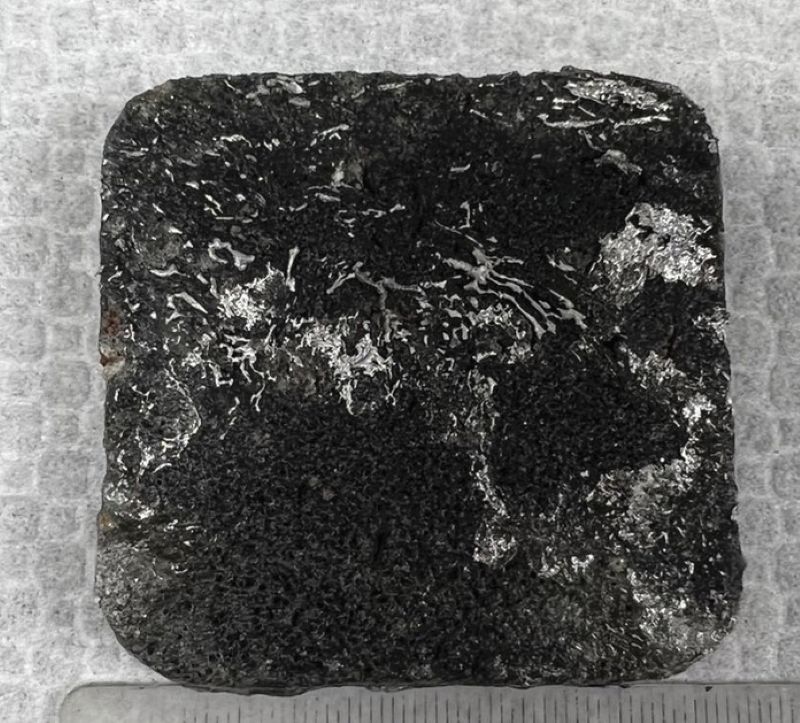
The tiles were made while simultaneously valorising raw materials made from sewage sludge acid-leaching residue and waste bottle glass.
The paper in the IOM3 journal, Advances in applied ceramics: structural, functional and bioceramics, reveals that 'the addition of 6M sodium hydroxide, 6wt.% sodium aluminate and 8wt.% calcium hydroxide reduced the sintering temperature from 1,100°C to 750°C and enhanced the performance of the produced ceramic tile.
'Under optimal conditions, with a sewage sludge acid-leaching residue:waste bottle glass mixing ratio of 1:2, solid-liquid mass ratio [of] 2:1 (g/g), and sintering duration of 75mins, the produced ceramic tile achieved a bending strength of 6.5MPa, bulk density of 1.61g/cm³, water absorption of 12.5% and porosity of 12.5%,' reads the research on Innovative sintering process for ceramic tile fabrication using a ternary alkali agent to reduce temperature and enhance performance.
Paper authors at National Taipei University of Technology, Taiwan, claim the study demonstrates that ceramic tiles can be produced through a 'cleaner process' given the lower firing temperature requirements and the direct use of waste materials.
The process consists of several key steps. First, the sewage sludge acid-leaching residue and waste bottle glass are collected, crushed and sieved. The powders are then mixed at a controlled ratio and combined with the alkali agent to form a slurry with a fixed solid-liquid ratio.
The slurry is poured into moulds and mechanically compressed to form a green body that is sintered at 700-850°C, with optimal performance observed at 750°C.
During sintering, alkali-induced reactions form interconnected silicate and aluminosilicate networks, enabling densification without high-temperature melting. The final products were evaluated for physical properties, microstructure and heavy-metal leaching behaviour.
Dr Yan-Jhang Chen and Professor Li-Pang Wang at the university explain, 'The results confirmed that heavy-metal leaching concentrations comply with relevant regulatory standards.'
The pair continue, 'In this system, hydroxide ions chemically activate silica- and alumina-rich phases in the raw materials, disrupting the original silicon-oxygen-silicon and aluminium-oxygen-aluminium networks.
'NaAlO₂ provides reactive aluminium species that promote the formation of sodium-aluminium-silicate structures, while Ca(OH)₂ further reacts with silicate species to form calcium-silicate and calcium-aluminium-silicate networks. These reactions significantly lower the energy barrier for densification.'
The performance improvement is reportedly achieved through chemical bonding evolution and microstructural densification, also induced by the ternary alkali agent.
The ternary system enables multiple binding networks to coexist, including nitrogen-gold-sulphur-oxygen and calcium-based silicate structures. 'This results in reduced porosity, improved particle bonding and enhanced load transfer within the ceramic matrix,' say Chen and Wang.
They are preparing patent applications in some countries and say the process shows potential for scaleability using conventional ceramic tile manufacturing steps, commonly available chemical reagents and sintering temperatures compatible with existing industrial kilns.
Further pilot-scale testing is required to confirm process stability, operational control and product consistency under industrial conditions.
The team also intends to carry out durability testing under long-term use conditions, optimise forming methods suitable for industrial production, and further evaluate energy and environmental performance.
IOM3 members can access all of the Institute’s journals as part of their member benefits by logging into the site.