Key trends in African critical mineral projects – The role of infrastructure corridors
Africa continues to show strength in mining and is emerging as an epicentre for critical minerals.
Many African sourced minerals are the backbone of clean energy technologies such as electric vehicle batteries, wind turbines, solar panels and hydrogen fuel cells. The continent currently holds:
- 30% of global mineral reserves relevant to clean energy technology;
- over 70% of global cobalt production, primarily from the DRC; and
- significant untapped deposits of lithium (Zimbabwe, Namibia and Ghana), nickel (Tanzania and Madagascar), graphite (Mozambique and Tanzania) and iron ore (Guinea).
Historically, Africa’s role in global mineral supply chains has been largely extractive, with raw ores exported and value adding activities (e.g. refining, component manufacturing and technology development) occurring outside the continent.
However, there is a growing push for Africa to break from this legacy. Various leaders and institutions from the African Union and the United Nations Economic Commission for Africa are calling for a shift toward vertically integrated value chains, regional industrial hubs and strategic resource governance. Initiatives like the Africa Green Minerals Strategy, the Africa Mining Vision and the African Continental Free Trade Area are all laying the groundwork for a more assertive and coordinated approach.
With global powers competing for access to Africa’s mineral wealth, the continent has a rare opportunity to leverage its resources for structural transformation and not just revenue. In the long term this means investing in infrastructure, skills and technology; enforcing local content and beneficiation policies; and ensuring that communities benefit from the mineral boom.
In this context, the rise of mega-infrastructure critical mineral projects across Africa reflects a broader shift. These projects are more than responses to global demand, they are manifestations of Africa’s intent to assert greater agency in shaping its economic future. By anchoring mineral extraction to infrastructure development, industrial policy and regional integration, these ventures offer a pathway to transformative growth. However, effective governance and enforcement will be critical to ensuring that resource development translates into long-term national benefit.
Infrastructure corridors
Africa’s mineral wealth is vast, but much of it lies in regions that are geographically isolated from global markets. Countries like Zambia, the DRC, Malawi and Niger are rich in copper, cobalt and other critical minerals, yet they face logistical hurdles that limit their ability to fully capitalise on these resources. Many of these nations are landlocked and the infrastructure often outdated, fragmented or overstretched.
This is not simply a legacy of underdevelopment, but a reflection of historical patterns. Much of Africa’s transport infrastructure was originally designed to move raw materials out of the continent efficiently, rather than to support integrated regional trade or domestic value addition. Today, this results in logistics costs that are up to 250% higher than the global average, with poor connectivity adding 30-40% to operational expenses for mining companies. Border crossings can be slow and complex, energy grids are frequently unreliable, and the capital required to modernise infrastructure remains a barrier for many governments and investors.
However, these challenges also present a clear opportunity. Across the continent, there is a growing recognition that unlocking mineral wealth must go hand-in-hand with building the infrastructure to support inclusive growth. Recent examples showcase a new generation of African mega ventures that aim to integrate resource extraction with infrastructure, industrial policy and community benefit.
Simandou
The Simandou project in Guinea is structured with long-term national benefit and community integration at its core. Valued at US$24bln, Simandou is the largest integrated greenfield mining and infrastructure development in Africa’s history. It encompasses four iron ore blocks, a 600km multi-use railway and a new deepwater port on Guinea’s Atlantic coast.
The project is being delivered through Compagnie du Transguinéen, a joint venture between Guinea, Rio Tinto, Chalco Iron Ore Holdings and Winning Consortium Simandou (a Chinese-led consortium). This multi-stakeholder model ensures that Guinea retains a direct stake in the infrastructure and mining assets, embedding national ownership into the project’s DNA.
Crucially, the infrastructure is multi-use and multi-user, meaning the railway and port are not exclusive to Simandou’s operators. This opens the corridor to other mining and agricultural producers, catalysing broader economic development across the region. The project also embeds robust ESG commitments, including community development, environmental safeguards and local employment.
The project saw its first shipment of iron ore on 11 November 2025.
The Lobito Corridor
The Lobito Corridor is an initiative linking the DRC and Zambia’s Copperbelt to the Atlantic port of Lobito in Angola via a 1,300km railway. Backed by a coalition of public and private partners including the U.S. International Development Finance Corporation, the European Union Commission, the African Development Bank and the Africa Finance Corporation, the Corridor is being developed as Africa’s first open-access rail system.
The Corridor is designed to reduce usual export times from 30 days to eight, and is structured to support multi-user access. Angola is expected to receive over US$2bln in concession fees and the project includes plans for solar power installations, agro-processing hubs and job creation initiatives along the route.
The TAZARA Railway
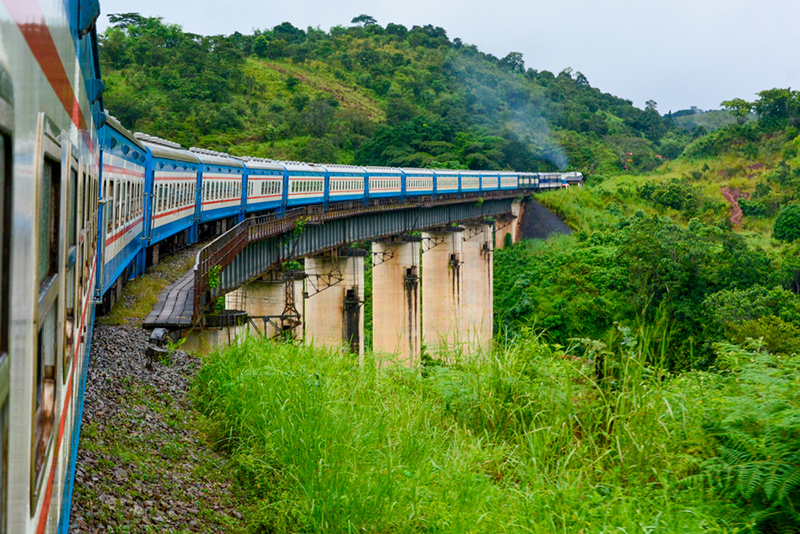
The TAZARA Railway, originally built in the 1970s with Chinese support, is undergoing a US$1.4bln revitalisation led by China Civil Engineering Construction Corporation. The 1,860km line connects Zambia’s Copperbelt to the port of Dar es Salaam, offering an eastern outlet for mineral exports and reinforcing China’s infrastructure footprint in East Africa.
Under a new 30-year concession, the project will deliver new rolling stock alongside major upgrades to rail infrastructure. The TAZARA Railway’s strategic role lies in its ability to complement the Corridor, offering an alternative route to the Indian Ocean and supporting regional trade integration.
The TAZARA Railway is also being framed as a platform for regional cooperation, with Zambia, Tanzania and China emphasising its role in boosting trade, creating jobs and supporting industrial growth. The project includes environmental safeguards, community engagement strategies and efforts to formalise artisanal mining along the route.
This is an abridged version of an item that can be found on the Watson Farley & Williams LLP website.