It stands to resin
Geopolymers enhance rail track stability.
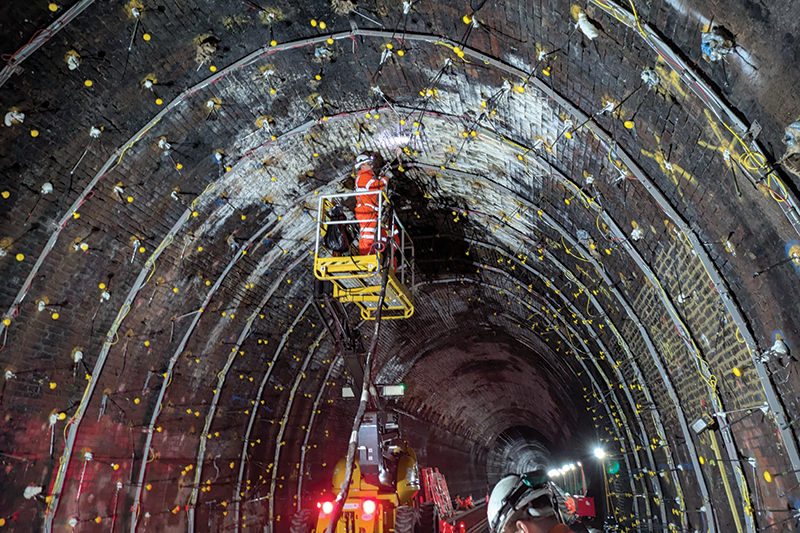
The first material innovation in rail transport came with the shift from wooden to metal tracks in the late 1700s, followed by the development of wrought-iron rails in 1820. These offered a safer and more reliable alternative to the brittle cast-iron rails of the time. Today, railways can be made even safer with the latest advancements in geopolymer resin.
Geopolymers are inorganic polymers with a 3D framework that gives them superior mechanical and physical properties.
In the 1980s, Finland adopted a geopolymer injection technology developed by Geobear, then known as URETEK. It was designed to improve the ground strength beneath built assets. Stabilisation occurs through formation of a sodium and calcium aluminosilicate gel, which binds to neighbouring soil particles and solidifies rapidly into a denser, stronger matrix.
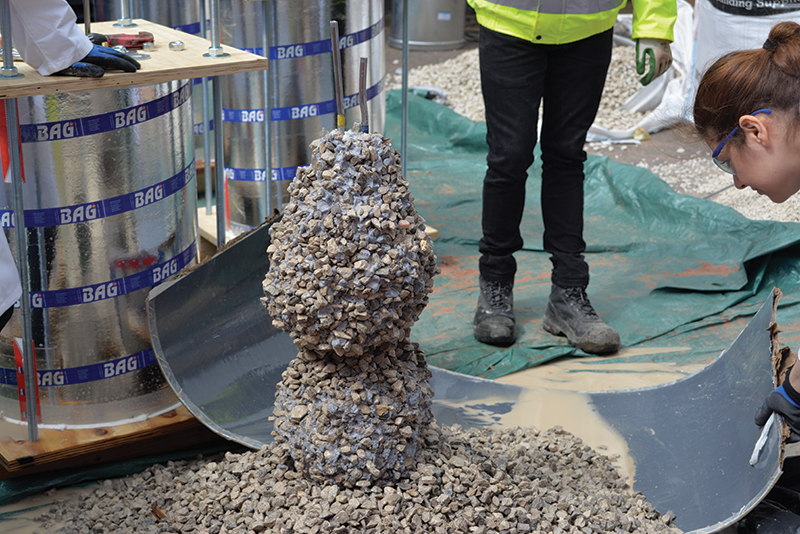
Technicians inject these expandable materials into the ground to fill voids and stabilise soils through compaction grouting. In granular soils, injections form expanding bulbs typically between 0.2-0.6m in diameter, compacting the surrounding soil.
The material’s properties make it highly adaptable to a variety of soils and conditions. It is therefore particularly suited for infrastructure projects where conventional grouts or mechanical solutions may be inadequate.
Over the last two decades, this technology has been used to resolve voiding and settlement beneath highways, and to support foundations and lift residential properties affected by subsidence. Its most recent application is in rail, addressing the persistent problem of transition zones.
Transition zones in rail occur where track-bed stiffness changes significantly over a short distance, most commonly at bridges, culverts and embankments.
The weakest link
One of the major engineering challenges in railway infrastructure is the degradation of transition zones, a problem made worse by high-speed rail and heavier axle loads. Studies in the early 1970s first identified how abrupt stiffness changes at these zones negatively affect track behaviour.
These abrupt changes increase dynamic wheel loads, accelerating differential settlement and track degradation. This process is self-perpetuating – greater settlement increases dynamic loads, which in turn causes further degradation.
The result is cracking of sleepers and tension clamps, ballast wear and penetration into the subgrade, and eventually loss of gauge.
Ballast, the layer of crushed stone or gravel on which the railway track is laid, provides stability and drainage. Over time, ballast wear appears as white spots caused by abrasion. Particles can also penetrate the subgrade, compromising the ballast’s drainage and load-bearing capacity.
Tension clamps, made from high-tensile or spring steel, are used to fasten the rails securely to sleepers. They absorb dynamic stresses from passing trains and prevent rail shifting, thereby improving stability and safety.
Sleepers, the rectangular supports beneath the rails, transfer loads from the track to the ballast and subgrade. They are vulnerable to cracking and fatigue, particularly when clamps lose integrity or the ballast becomes degraded.
Transition zones are therefore unique because they represent interfaces between structures with very different mechanical behaviours. Unlike uniform track sections, these areas are highly sensitive to small variations in load, subgrade composition and moisture content. Any uneven settlement can trigger a cascade of wear and deformation. These properties have earned transition zones the reputation of the ‘weakest link’ in railway systems.
Tracking the problem
The impact is both technical and financial. Between 40-75% of railway operating costs are spent on track maintenance to ensure safety and comfort, according to the study Design of railway transition zones: A novel energy-based criterion in Transportation Geotechnics.
The researchers also found that maintenance costs in transition zones can be four-to-eight times higher than in open track.
According to the study Implementing track transition solutions for heavy axle load service in 2005, around US$200mln is spent annually in the US alone on transition-zone maintenance, while, in Europe, the figure is estimated at €85mln. Beyond cost, degradation reduces passenger safety, ride quality and overall performance.
Although many factors contribute to deterioration, including track-bed composition, load characteristics and transition design, two issues stand out. Abrupt stiffness changes and differential settlement are consistently identified as the primary root causes, as discussed in detail by Coelho B. et al. in the Proceedings of the Institution of Mechanical Engineers, Part F: Journal of Rail and Rapid Transit.
The challenge has only grown in recent decades with faster trains, heavier loads and rising expectations for safety and ride quality. The study, Numerical evaluation of approach slab influence on transition zone behavior in high-speed railway track in Transportation Geotechnics, showed that increasing train speed from 120-300km/h leads to a 25% increase in deformation at transition zones. Jean et al., publishing in Frontiers in Built Environment in 2024, likewise concluded that degradation persists despite various mitigation measures.
Current approaches include double rails, changes in sleeper length and spacing, elastic pads under rails or sleepers, ballast mats, transition wedges and approach slabs.
Approach slabs are particularly effective in soft soils and are recommended by the American Railway Engineering and Maintenance-of-Way Association and the Toronto Transit Commission. These slabs typically measure at least 6m in length and 30cm in thickness.
Similarly, transition slabs are used in areas with either soft or highly compressible soils, such as the Netherlands, while granular transition wedges are used in areas with either stiffer or less compressible soils such as Spain and Portugal.
While effective in some situations, most maintenance solutions require excavation, which is disruptive, time-consuming and carbon intensive. In addition, these methods often require temporary removal of trains from service, adding economic and operational costs that can be difficult to justify on heavily trafficked lines.
Getting better at transitions
Geobear has developed and patented a method of strengthening railway track beds using geopolymer resins to create a gradual transition in ground stiffness. The technique improves the subgrade modulus by injecting different types of geopolymer with varying properties at different depths and volumes.
In cohesive soils, such as clay and silt, the resin spreads by hydraulic fracturing, expanding and solidifying to improve bearing capacity and stiffness. In granular soils, like sand and gravel, the resin permeates the subgrade and expands to form compact bulbs that densify the soil structure. In both cases, engineers select the material to adapt to the local geotechnical environment.
The material cures within seconds and 90% of the mechanical properties are reached within the first 15 minutes. The material typically reaches its final properties within 24 hours.
Technicians inject the geopolymer at varying depths for a gradual and stable change in stiffness, protecting transition zones effectively. The treatment zone dimensions are tailored to traffic load, train speed and existing soil stiffness.
For example, in a 7.5m treatment area, injections closer to a bridge abutment may use higher density, stiffer resins, while injections further away use lower stiffness formulations, creating a smooth gradient. This provides engineers with a proven, faster and more sustainable approach to maintaining transition zones.
The properties of geopolymer resin make it an attractive material for rail infrastructure. Unlike traditional methods requiring excavation, this geopolymer can be injected between sleepers with minimal disruption. Its rapid curing time of less than a minute allows for work to be completed during planned engineering hours or night possessions (taking over of rail infrastructure for maintenance), avoiding long closures.
Geopolymers are extremely lightweight, with densities of 150-300kg/m³, up to 10 times lighter than conventional grout. Higher densities yield compressive strengths up to 5MPa, and the density can be precisely selected to provide the required stiffness gradient.
Geopolymers can also expand by up to 40 times their original volume. Highly reactive formulations achieve larger expansion but lower density, making them suitable for slab lifting. Lower reactivity types produce less expansion but higher stiffness, ideal for ground strengthening.
Durability is another advantage. Where typical engineering fills have a fatigue life of 70 years, timescale modelling and endurance tests show that geopolymers can exceed 150 years.
Another key advantage of geopolymer resin is that it is completely water-free, which prevents any increase in soil moisture during treatment. Hardening occurs through an exothermic polymerisation reaction, and the absence of water makes it particularly suitable for remote rail sites where transporting water is challenging.
In addition to these practical benefits, geopolymers support sustainable engineering. Their stable molecular structure resists chemical attack and prevents contamination of soil or groundwater, which can be a risk with cementitious alternatives.
Geopolymers offer a low-carbon alternative to conventional concrete. Sustainability consultancy Carbon Footprint Ltd evaluated the carbon emissions from traditional, concrete, rail level-crossing replacement against Geobear’s life-extension method. The 10 Geobear treatments emitted ~75% less CO₂e than the traditional method. In total, this represented an overall avoidance of 149,780kgCO₂e.
Practical polymer performance
The concept for the patent emerged as Geobear expanded its infrastructure team, recognising both the potential of geopolymers and the urgent industry need. The main challenge was designing a treatment pattern that produced gradual stiffness transitions. With over 30 formulations available, the company developed bespoke solutions for a range of environments.
The patent was filed at the end of 2021 and awarded in early 2025. It covers the method of strengthening railway track-bed structures using geopolymer technology.
One example in practice is on the 267km Dublin to Cork main line – one of Ireland’s longest railways, carrying 3.66mln passenger journeys annually. The UBC4, a single-span railway bridge on the line, had experienced degradation due to its skewed geometry, which caused differential settlement at the abutments, leading to distortion and twist faults.
Reconstruction was not viable as it would have required weeks of closure. A fast, non-intrusive method was needed, one that could be completed during night possessions with no rail traffic. Geopolymer resin injection was selected to meet a target subgrade stiffness of 50-80MPa.
The engineers used borehole data and PLAXIS modelling, which is finite element analysis software to simulate and analyse the mechanical and hydraulic behaviour of soil and rock. In doing so, they defined a transition length of 13.8m, with treatment focused at a depth of 1.5m where 90% of strain occurred. The injection plan involved 528 points across four depths.
Completed over 19 night possessions, the project used 10t of geopolymer safely with zero incidents. Monitoring included repeated track geometry measurements and stiffness testing, confirming a 59-69% reduction in twist faults, with 75% of red fault locations downgraded to yellow or green.
The Young’s modulus increased significantly across the treatment area, demonstrating both immediate and long-term improvements in subgrade performance.
Restoring balance and binding ballast
While the patent addresses the specific challenge of transition zones, geopolymer technology can also be applied to ground improvements in other rail applications, including void filling, subgrade stabilisation and under-track crossings.
In Poland, the embankment of railway line No. 275, the main connection between Wrocław and Berlin, Germany, had become unstable, deformed and settled.
Situated in marshy terrain with limited access, traditional methods would have been time-consuming and required temporary roads to be constructed for machinery and material supply.
An advantage of geopolymer technology is that it does not require heavy machinery and avoids track dismantling. At this site, Geobear deployed specialists using rolling stock on a track closed to traffic.
Engineers identified a 100m treatment zone using finite element method software. They used multi-level injections to restore embankment stability. The specific geopolymer formulation also reduced soil particle washout by limiting subsurface infiltration and providing a hydrophobic barrier.
Ballast binding is a technique engineers use to prevent ballast migration. Traditional ballast binding applies concrete to improve stability and longevity of ballasted tracks where erosion and movement are evident.
Geopolymer can also be used in this case. On the Glenn Douglas railway in the UK, the line relied on a King Post retaining wall – a structural fence designed to hold back earth to hold the ballast in place. Over time, the wall deteriorated, causing ballast to wash down the embankment and creating structural instability.
A complete rebuild of the retaining wall was deemed impractical due to high costs, complexity and the potential for extended closures. Building a new wall in front of the existing one was also considered, but still carried significant cost and disruption.
Geobear proposed geopolymer injection to bind the ballast. This approach prevented ballast migration through the deteriorated sleepers and allowed partial reconstruction of the wall’s base with minimal disruption. The engineering team completed the project over seven scheduled possessions, effectively stabilising the track and preventing ballast and track movement along a 72m section.
From the ground up
Beyond rail, geopolymers are already used in roads, housing, utilities, airports and seaports. Their low-carbon footprint, fast curing times and long service life position them as a sustainable alternative to conventional construction materials.
The future likely includes wider adoption in the infrastructure sectors, with the recent patent proving to be a large step towards engineering trust in geopolymer resin technology for ground engineering.