If it’s made, it’s conveyed
Making moves on a new conveyor belt
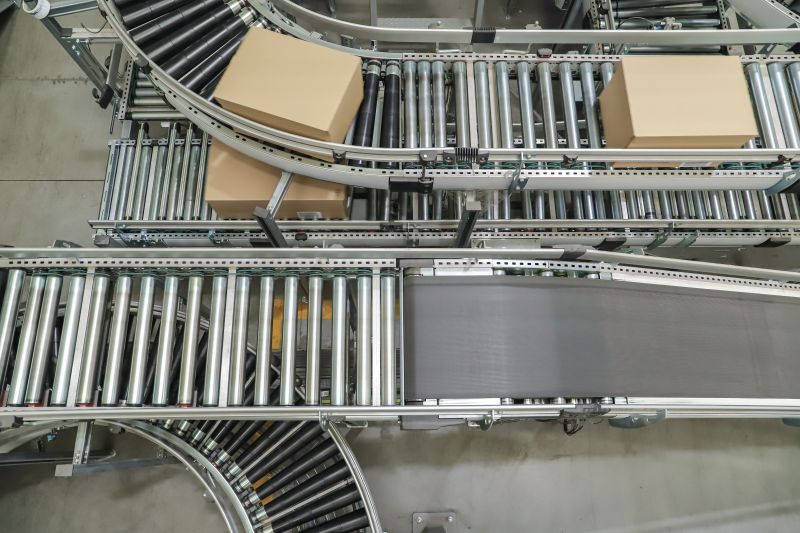
It is fair to say, that if it is made or grown and packaged, it has been conveyed.
Conveyor belts are an integral part of our everyday world. From the processing of potatoes to production of pillows and quilts, they convey the goods we use and play an active part in manufacturing them. Indeed, some processes rely on the specific make-up of the belt’s design.
To cover such a vast array of applications, there are thousands of belt products from more than 40 mainstream manufacturers globally. Around 60% of the global belting market is controlled by three companies and their global supply networks.
Smaller companies support several local end-users and often in a particular industry sector like processed food production. The larger the belting company, the more industry sectors they tend to support.
There is a well-established production base across Europe, Japan and North America. However, the largest growth area for belt manufacture is in China, to produce goods at ever-reducing costs and to cover the demand of an annual global growth rate of around 12% for the belting market – according to Henry Royce.
The belts all fall into one of two general types – those made of PVC and those made of polyurethane (PU).
They are both made by layering woven polyester substrate, with the PVC or PU coating the working surface, the interlayer(s) and the running surface.
Heavy-duty rubber belts used in quarries, mining and general outdoor conveying are not included as they do not fall into general belting. The materials that make them and their entire structures are far removed from what is termed ‘lightweight belting’.
Large impact
Belt use has a substantial impact on resources. Research by the Sustainable Materials Innovation Hub at the Henry Royce Institute reveals an estimate of more than 50bln litres of water used and over 2Bt of CO2e emitted from primary production alone, with further impacts relating to secondary and tertiary manufacturing, as well as fitting belts to machines and the associated travel to and from sites.
In most cases, a roll of belting material – a ‘slab’ – is made with dimensions of 100m x 2m, with widths up to 5m possible but 3m being more common.
Once manufactured, these slabs have already created a waste stream of around 1%. This is from trimming the salve edge to create a straight datum edge used in the production workshop. These trimmings are automatically consigned to landfill or incineration.
Likewise, although multiple slabs may be coated at the same time, there is also varying lengths of ‘lead’ and ‘tail’ – material falling outside of the products standards, due to the nature of starting and ending a production run. This increases waste to an average of 1.6%, constituting a substantial, continuous and avoidable waste stream.
Each belt manufacturer, be it a member of a larger network or an independent company, will purchase many slabs of various types to support their clients’ demand.
The percentage of belts that need splicing onsite varies from industry to industry and specific applications within. For example, in an industrial bakery, around 60% of the belts will be spliced onsite as their dimensions or design do not allow for them to be fitted endless or with a mechanical fastener.
In a logistics or sortation environment, around 80% will be spliced in place, as most belts are too long to be supplied endless and mechanical fasteners are generally only used in emergency breakdown scenarios.
Did you know?
The first mention of a mechanical belt drive using a pulley machine was in the Dictionary of Local Expressions by the Han Dynasty philosopher, poet, and politician Yang Xiong in 15BC. It was used for a quilling machine that wound silk fibres onto bobbins for weavers’ shuttles.
Source: Needham, Science and Civilization in China (1988), Volume 5, Part 9
In the high-risk food processing applications, such as meat and cheese, as low as 15% of belts will be spliced in place, with most supplied endless. Here, machines are designed for everyday removal of belts for clean-down after a production run.
It is a well-established norm that more than 86% of belts – no matter the joint type or origin of manufacture – are replaced prematurely due to joint failure. But the belt carcass still has usable life at the point it is replaced.
The belt joint, welded or mechanical, is only around 33% the strength of the carcass and therefore represents a ‘weak link’. Even when metallic clips are used, the joint is never more than 36% as strong as the carcass. In most cases, only a welded splice will suit the application.
Put to bed
In 2017, the author of this article was working with a new client to resolve their belting issues.
The entire production process for pillows and quilts is totally reliant on conveyor belts with an excess of 600 belts, plus transmission and timing belts.
Mostly the products are made from forming non-woven polyester fibres into a layered sheet for quilts or a tight bundle for pillows, which are then covered by an outer woven cotton material.
Within the non-woven textile industry, fibre build-up within the process is a primary mode of belt damage that usually takes the form of the belt splice bursting. These belts are replaced with the damaged belt being consigned to landfill, or in small cases incineration.
The contamination is due to loose fibre strands grouping together, building up and balling under the belt, collecting in the tracking groove of the rollers.
This fibre contamination then grows as it is compacted under the tensioned belt, to a point where it causes increased tension on that side of the belt and is forced to track over to the looser side.
This looser side rubs against the frame of the machine applying adverse pressure. As the end finger of the splice splits, the belt indexes over one finger space more. The process repeats until failure.
One belt stood out from the rest and was being ordered for the third time in 10 months. It was replaced approximately every 3.5 months in the 12 years since the machine had been installed. Each time, this was due to the same joint bursting on the left-hand side.
There had been many attempts by both belt suppliers and internal engineering teams to resolve the issue.
Air blowers and static eliminators had been installed to reduce or eliminate fibre contamination. Belt suppliers tried to make the belt joint more resistant to the contamination, but neither of these proved effective.
The client tried a metallic clip joint, but the same damage occurred over a similar lifespan. Instead of a finger splitting, the metallic clip would pull free from the belt end. However, it was easier, faster and less costly to replace.
Pulling off the sheets
On investigating further, it was immediately clear what the main issue was. The belt carcass gets its dimensional stability and strength from single or multiple layers of woven polyester fabric, coated and layered in different formats to make the particular belting product.
However, the splice is reliant solely on a thermal bond of PVC or PU, along the intersection of the conjoining fingers from each end of the belt. The specific strength is dependent on the amount of surface area bond – the longer and narrower the fingers, the greater the overall bond strength.
Due to the physical restraints of finger punching tooling and the welding width of a joining press, it is not possible to simply elongate the finger to the extreme. Typically, 80mm x 15mm for PVC and 50mm x 20mm for PU is the industry norm. Polyurethane has a stronger bond than PVC.
A variation of the splice involves splitting the plys and staggering the fingers of each ply, but this is generally not accepted as a fix.
Meanwhile, to simply overlap the ends would create a stiff splice that would require a larger minimum pully diameter. It also has the negative effect of creating a hinge point behind each side of the overlap, which then becomes the primary mode of failure.
The author has a sound working knowledge of fabric reinforcement and, in particular, para-aramids from his previous 30 years working with polytetrafluoroethylene (PTFE)-coated composite belting and architectural membranes, such as the tents to house the Muslim pilgrims in the Mina Valley, Saudi Arabia. He set about looking into the possibility of integrating a localised section of para-aramid with the belt to increase the splice strength.
Belted up
The major challenge was how to integrate such a fabric section while maintaining the bond between the belt layers to avoid delamination during its running. After many trials and tests, a potential solution was found through a project named Invictus.
In a belt-fabrication workshop, rather than a scientific laboratory, the only way of testing the new development was to fasten the splice over the end of a tube affixed in a vise.
Then a M14 bolt and a 2kg lump hammer were used to try and burst the splice. The convectional splice burst after two strikes. After more than 60 strikes on the Invictus splice, there were markings on the belt surface, the body concaved, but there was no splice failure (see image above).
The belt was relatively small at 2.525m x 2.245m (5.66m²) with a mass of 13.07kg, which is consistent with PVC tracking cords, and was made up from 61% polyester and 39% PVC.
The cost was around £900. However, this pales into insignificance when the cost of the downtime is calculated into the breakdown. The loss of productivity, engineering time and re-start costs are a much larger portion of the overall cost for a standard belt – estimated at around £6,400 over the three-hour timeframe.
The new belt continued to run past the 3.5 months, then a year, then two years. On a regular basis it was checked and, although damage was still occurring down the left-hand side
of the belt, the splice held firm.
Belts were then trialled in some of most demanding applications to get some real-world exposure to the technology, amassing around 30 live trials.
In 2022, the author partnered with a peer within the industry, David Waite FIMMM, and together – with existing business partners – they formed Ecobelt Ltd to take the technology global.
Waite recognised the additional sustainability advantages of this technology versus the industry standard of use and replace. They could make belts last longer by eliminating the ‘weak link’ each belt has within the splice.
A patent application process began with the technology now taking the name AnnStuMax® after the author’s three children – Annessy, Stuart and Maximillian.
The team then immediately set about seeking scientific verification of the technology’s attributes and enlisted the help of the Sustainable Materials Innovation Hub of the Henry Royce Institute at Manchester University, UK. First, the puncture resistance and the tensile strength of the splice was tested against a historical standard splice.
The results were impressive and showed that the tensile values of AnnStuMax were more than twice as strong in tensile and up to 4.88 times as strong in puncher resistance. Various versions of the splice were tested and each result was a reflection of the expected performance.
Following on from this, a Life Cycle Assessment was commissioned with the university (see box-out below). The results form the basis of a white paper due to be published and highlight the environmental credentials of AnnStuMax in the belting world.
It is important to note that the net effects of a belt’s lifespan increasing has far-reaching positive effects way beyond the cost of replacing the belt. When a belt life increases, it inevitably has the obvious effects of reducing replacement and downtime costs, increasing productivity and the productive yield, reducing running costs, waste and the demand on the engineering team, and improving the profitability of the process.
These effects are often overlooked by the client as focus tends to be towards fire-fighting issues that are constantly arising and not on those that have already been solved.
The savings for this belt are not finalised as it is still running three years past its expected lifespan and seven-and-a-half years past the historical norm.
Following the granting of the UK patent and the international patent in progress, AnnStuMax has been used on hundreds of belts.
With its capability to be used in almost all belt grades and in all applications, less belts will be needed to replace the premature failures, reducing the heavy demand on resources and increasing the efficiencies of processing goods.
Life Cycle Assessment
With the help of Manchester University, UK, the new belt technology AnnStuMax was taken through a Life Cycle Assessment.At the time of this publication, the net effects are:
Savings of £163k in belt replacement and associated downtime costs
Preventing 262kg of PVC belting going to landfill
Preventing 262kg of PVC material used for replacement belts
Saving 90,000L of water used in primary production
Saving 9,600kWh of electricity for primary production of replacement belts and 1,987kg of CO2e