Fired up about ceramics
Decarbonising ceramics production with hydrogen
The global journey towards net-zero emissions is driving high-temperature industries, including ceramics manufacturing, to explore a wide range of alternative fuels. Among these, hydrogen offers unique combustion characteristics that may contribute to decarbonisation.
It is gaining momentum across multiple energy-intensive industries, including glass, cement, steel and brick manufacturing. Governments worldwide are investing in hydrogen research and policies are being developed to facilitate its adoption.
As hydrogen infrastructure improves and costs decline, its role in industrial decarbonisation is likely to expand.
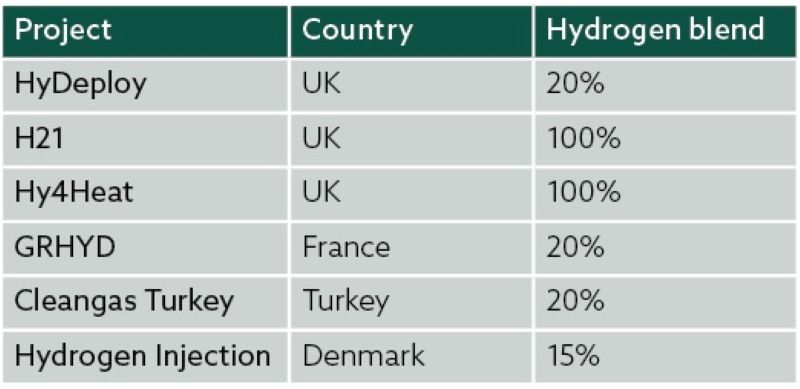
Several countries are exploring hydrogen blending into natural gas networks as an intermediate step towards full hydrogen adoption. These initiatives provide valuable insights into hydrogen combustion behaviour and aid industries in adapting to hydrogen-based processes.
The main advantages of using hydrogen in ceramics production include:
- Zero-carbon emissions – unlike natural gas, which releases carbon dioxide when burned, hydrogen combustion results in only water vapour, helping global decarbonisation efforts.
- Regulatory compliance – many governments are tightening emissions regulations. Transitioning to alternative fuels can help manufacturers comply with stricter environmental policies.
- Energy security and futureproofing – as fossil-fuel availability fluctuates, alternative fuels present a long-term, sustainable, energy source for industrial applications.
- High-combustion efficiency – hydrogen burns at a higher flame temperature than natural gas, which can improve kiln efficiency and reduce firing times.
- Versatility in production – hydrogen can be generated using various methods, including green hydrogen production through electrolysis powered by renewable energy sources.
- Lower long-term costs – while initial investments in infrastructure are high, operational costs could decline as alternative fuel production scales up and energy efficiency improves.
However, the transition to any new fuel is not an easy path. Several issues must be addressed for it to be a viable long-term energy solution, namely:
- Impact on refractory linings – the higher water vapour content from hydrogen combustion can interact with refractory materials, leading to increased corrosion and reduced lifespan of kiln linings. New refractory formulations may be needed to enhance durability.
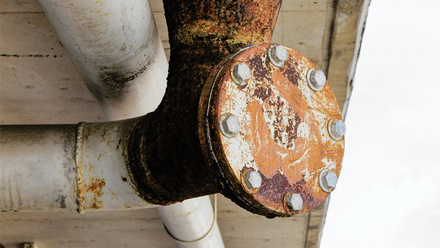
- Hydrogen embrittlement – hydrogen diffusion into metal components, such as valves and pipelines, can cause embrittlement and structural failure. This necessitates the development of hydrogen-compatible materials to ensure long-term operational safety.
- Increased water vapour and its effects – hydrogen combustion generates more water vapour than natural gas, which can interact with raw materials in ways that alter final product properties. Process adjustments and atmospheric control in kilns, as well as monitoring the exhaust gases, will be crucial to mitigate these effects.
- Infrastructure and cost considerations – hydrogen infrastructure, including pipelines, storage facilities and burners, requires significant investment. The cost of producing green hydrogen through electrolysis remains a barrier, although advances in renewable energy are expected to drive this down. Additionally, hydrogen has different combustion characteristics compared to natural gas, requiring modifications to existing kiln infrastructure and firing methodologies.
Testing hydrogen’s effects on product quality, kiln operation and material interactions is therefore crucial in providing clarity on whether it is a suitable fuel for specific processes.
De-risking hydrogen
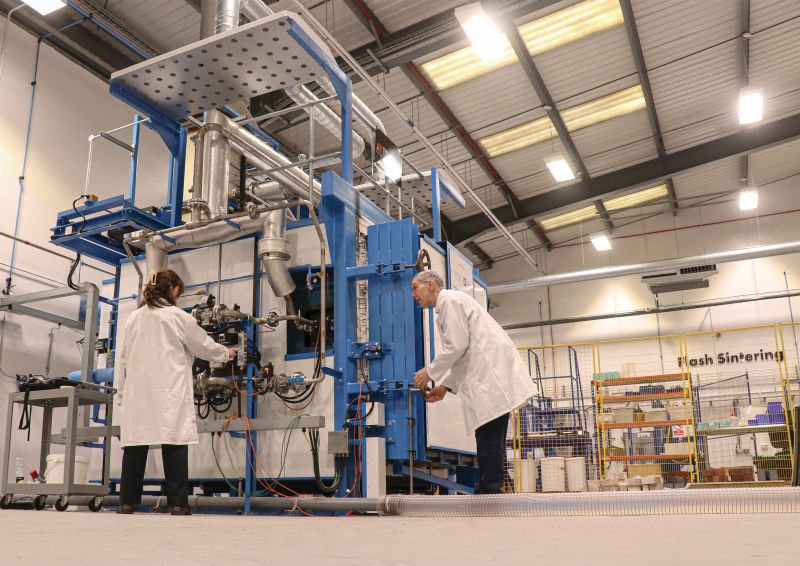
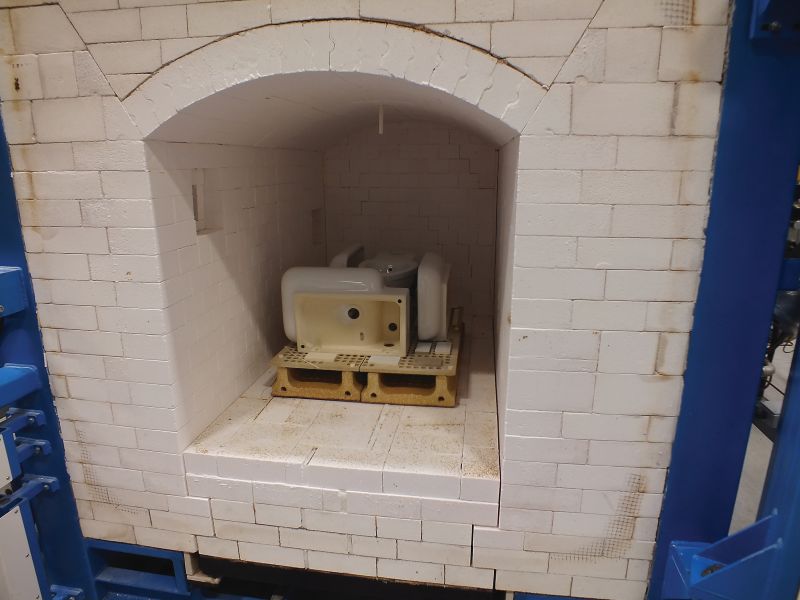
Lucideon operates kilns capable of reaching temperatures of up to 3,000°C in oxidising, reducing and inert atmospheres. This allows for precise control over the firing environment, crucial for producing high-quality ceramic products.
The continuous kiln features multiple burner ports, enabling fine-tuning to accommodate different fuel blends at various production stages. By using blends of hydrogen and natural gas ranging from 1-100% hydrogen, it is possible to tailor the firing environment to specific product needs, optimising properties and ensuring the transition to hydrogen does not compromise quality.
For instance, hydrogen can be used during the ramp-up and cool-down stages, with a switch to a mixture or pure natural gas during the sintering stages, maximising efficiency while minimising environmental impact.
The following comparative study sheds light on how ceramic sanitaryware products respond to hydrogen firing versus traditional natural gas firing. The testing adhered to industry standards, including TS EN 997 for toilets and TS 14688 for washbasins.
The parameters assessed include thermal-shock resistance, chemical resistance, shrinkage, water absorption and firing strength.
Thermal-shock resistance is critical for sanitaryware as products must endure sudden temperature fluctuations during everyday use. Water-absorption measurements reveal there is no significant difference between hydrogen-fired and natural gas-fired samples, indicating similar resistance to thermal shock.
Chemical-resistance tests have confirmed that both firing methods produce chemically durable surfaces capable of withstanding exposure to common cleaning agents without deterioration. This finding is crucial for ensuring the same longevity and maintenance standards as traditional products.
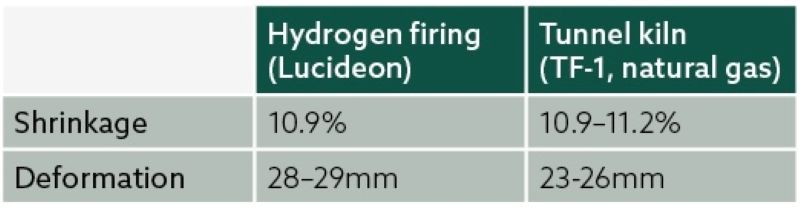
Shrinkage and deformation were key factors examined in the study (see table above). It reports shrinkage of hydrogen-fired products to be consistent with that of natural-gas-fired products.
The deformation is slightly higher due to a firing temperature of 1,223°C, which is 11°C higher than the natural-gas-fired kiln. However, the values are within acceptable industry standards.
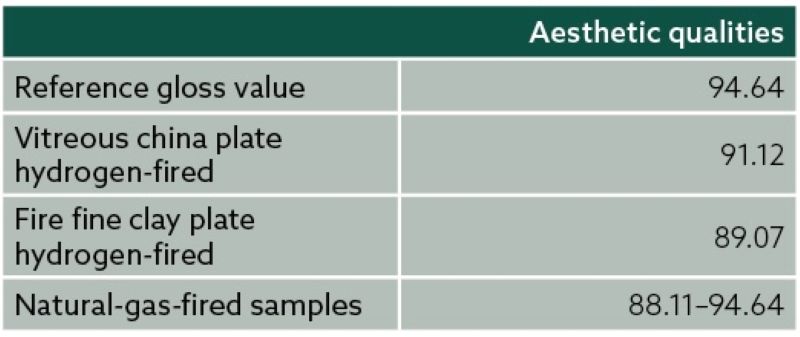
Aesthetic qualities play a significant role in sanitaryware manufacturing. The surface gloss of hydrogen-fired samples has been compared with reference values (see table above). While the gloss levels of hydrogen-fired samples are slightly lower, they still fall within the acceptable range. These minor differences are unlikely to impact consumer perception or market acceptance.
The structural integrity of ceramic products depends on their crystalline composition. X-ray diffraction analysis has confirmed that the mineralogical structure of these hydrogen-fired products is identical to natural-gas-fired products. This means that hydrogen firing does not alter the sanitaryware’s fundamental phase composition, ensuring mechanical properties are consistent.
Strong potential
Overall, the results show hydrogen-fired products perform equivalently to natural-gas-fired ones, making hydrogen a viable alternative for the ceramics industry. With further advancements in material science, process optimisation and infrastructure development, hydrogen has the potential to be one of the main fuels of choice for high-temperature manufacturing processes.
As industries navigate the transition to net-zero emissions, the ability to explore alternative fuels without undue risk is essential.
The facility at Lucideon has been made possible through funding from the Foundation Industries Sustainability Consortium (FISC) and its Economic Materials Innovation for the Sustainable and Efficient Use of Resources (EconoMISER) programme, and the UK Research and Innovation programme’s Strength in Places Fund (SIPF), to enable manufacturers to make well-informed choices about their future energy strategies based on scientific analysis and practical feasibility assessments.
Beyond traditional ceramics
While ceramics manufacturing is one of many energy-intensive industries exploring alternative fuels, numerous others are also investigating how to achieve decarbonisation.
- Glass production – requires extremely high temperatures, traditionally achieved using natural gas or electricity. Alternative fuels can replace natural gas in glass furnaces, significantly reducing CO₂ emissions. However, the increased presence of water vapour from hydrogen combustion could impact glass quality, requiring further refinement in process control.
- Refractories and heavy ceramics – typically manufactured through pressing, extrusion and firing processes, they often involve clay-based raw materials blended with minerals and additives to enhance performance. Hydrogen-fuelled kilns are proving viable for producing heat-resistant materials required in industries such as steelmaking and aerospace.
- Steel and metal production – the steel industry is one of the world’s largest CO₂ emitters. Alternative fuels can replace coking coal in blast furnaces, leading to the production of ‘green steel’. Some companies are already investing in hydrogen-based steel production as part of their long-term sustainability strategies. Most recently, Swedish project HYBRIT showed that it is technically possible to store hydrogen gas for fossil-free iron and steelmaking on an industrial scale. The storage offers the possibility of reducing the variable operating costs of hydrogen production by up to 40%, the companies behind it say.
- Cement manufacturing – cement production is another major contributor to industrial emissions. Traditional kilns rely on coal and petroleum coke, which generate significant carbon emissions. Alternative fuels can serve as a cleaner source of energy, although challenges related to process stability, clinker formation and increased water vapour need to be addressed.
- Concrete – the production of concrete and other construction materials like brick relies heavily on fossil fuels for heating raw materials. Alternative fuels can help decarbonise this industry, reducing both operational emissions and embodied carbon in building materials.
- Medical and advanced ceramics – high-precision ceramics used in medical implants and electronic components benefit from additive manufacturing techniques and hydrogen’s clean combustion process.
For more like this...