Finer materials
Could enhanced grinding of materials be the key to circularity and energy efficiency in the built environment?

Crushing and grinding processes, collectively referred to as comminution, underpin a vast range of industrial activities, including mining, construction, recycling and critical materials processing. Across these sectors, there is an increasing need to reduce both natural and man-made hard materials to fine and ultrafine powders to unlock and enhance their functionality.
This reliance on comminution comes at a significant cost. Crushing and grinding processes across industries account for around 6% of global energy consumption, and this figure is expected to increase, according to a study on Modeling of energy consumption factors for an industrial cement vertical roller mill by SHAP-XGBoost: a “conscious lab” approach in Scientific Reports.
Growth in mining to support the energy transition, rising construction demand, stricter environmental regulation and the expansion of circular economy practices will all increase the need for grinding capacity.
Global demand for mineral resources is projected to increase substantially. Mining activity is forecast to rise by approximately 60% over the coming decades, according to the Organisation for Economic Co-operation and Development in 2025.
Construction output is also expected to increase by around 50% by 2050, reports the 2050 Cement and Concrete Industry Roadmap for Net Zero Concrete from the Global Cement and Concrete Association (GCCA). These trends imply a major expansion of comminution activity. At the same time, the drive towards net-zero emissions and circular material flows is altering both the composition and quality of materials being processed.
Against this backdrop, it is timely to reassess both the role of grinding in a sustainable future and the technologies used to deliver it.
Changing material streams
Concerns over the security of supply of strategic and critical raw materials are intensifying, particularly those required for renewable energy technologies, electrification and advanced manufacturing.
One route to mitigating scarcity is to extract greater performance from smaller quantities of material. Increasing surface area through finer grinding can enhance reactivity and efficiency per unit mass, as demonstrated historically in catalyst development. While nanotechnology addresses similar challenges at the atomic scale, mechanical grinding remains the most scaleable and industrially robust approach for bulk materials.
A parallel consequence of mining growth is increased waste generation.
The International Energy Agency’s Global Critical Minerals Outlook 2025 reported demand for key energy transition materials, including lithium, copper, nickel and cobalt, will increase by factors of three to six by 2040. Coal mining, although declining in parts of Europe, still produces approximately 9,000Mt annually worldwide, says the China industry report of bulk industrial solid waste. The associated extraction, washing and processing generate around 1,800Mt of waste – known as coal gangue or coal slag – equivalent to ~40% of global cement production.
Large stockpiles of coal ash and slag persist in China and Europe – posing long-term environmental, land-use and safety challenges. If these materials could be mechanically activated through ultrafine grinding, they could be repurposed as supplementary cementitious materials (SCMs). This would reduce the embodied carbon in construction, while simultaneously reducing reliance on additional mining and virgin raw materials used for conventional cement clinker production.
Among emerging SCMs, calcined clay has attracted significant attention due to its abundance and non-waste origin.
Limestone-calcined clay cement (LC3) formulations typically reduce CO₂ emissions by up to 40% compared with ordinary Portland cement, according to the LC3-Project – a consortium of research institutions and companies, including EPFL in Switzerland, CIDEM in Cuba and CalClay Europe. Construction-sector net-zero roadmaps, like the GCCA one listed above, increasingly identify clinker reduction and diversification of SCM supply as near-term priorities.
However, most alternative SCMs require activation to achieve sufficient reactivity. Activation can be achieved thermally, but this introduces additional energy demand and associated CO₂ emissions. Mechanical or mechano-chemical activation (MCA) offers a lower-carbon alternative by enhancing surface reactivity through intensive grinding.
The challenge is that current MCA approaches rely largely on heavily modified ball mills, which can require up to 10 times more electrical energy than conventional cement grinding, finds the study Mechano-chemical activation in the International Cement Review. As a result, many abundant and sustainable materials – including low-grade clays, industrial slags and demolition waste – remain underutilised despite their theoretical and laboratory-demonstrated potential.
A hard grind?
Grinding has been central to human development for millennia. Early civilisations, including those of Mesopotamia, Egypt, Greece and Rome, used manual grinding to produce flour, pigments, medicines and construction materials. Rotary grinding stones represented an early technological advance, enabling more consistent size reduction.
During the Medieval period, animal-, wind- and water-powered mills dramatically increased grinding capacity and spread widely across Europe and Asia. In parallel, falling-weight hammer mills were adopted in mining operations to crush ores. The Industrial Revolution introduced steam and later electric power, enabling large-scale comminution and the development of ball mills, hammer mills and, in the early 20th Century, vertical roller mills (VRMs).
Throughout the 20th Century, improvements focused largely on scale, wear resistance, roller and table geometry optimisation, plus process control, rather than fundamental efficiency. While these developments supported mass industrialisation, the underlying grinding principles changed little. Today’s sustainability, energy and circularity demands expose limitations rooted in technologies conceived for a different industrial era.
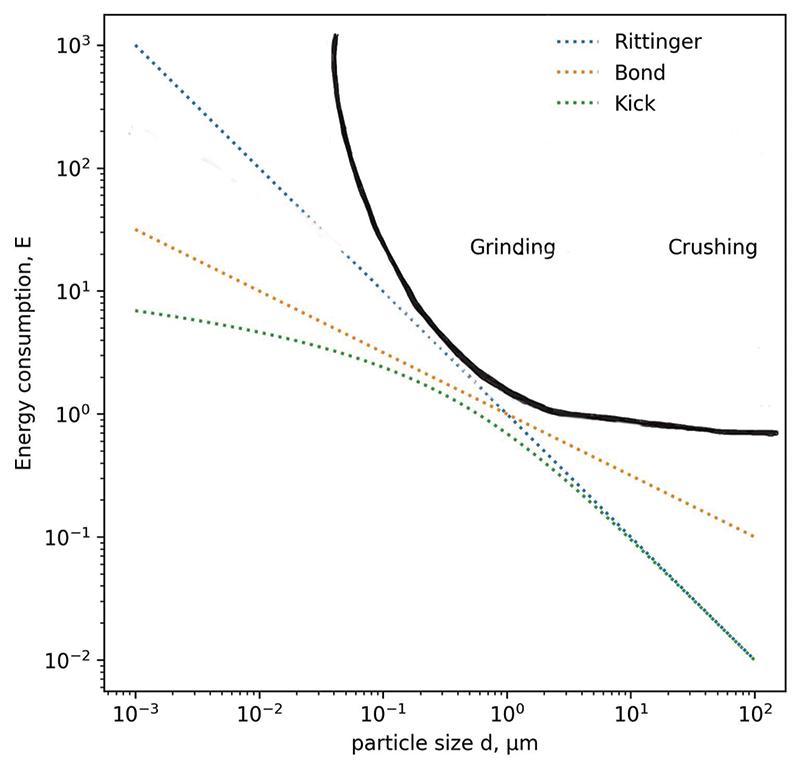
Comminution is already the dominant electrical energy consumer within cement plants, accounting for around 60% of total electricity use. While the initial crushing of minerals to centimetre-scale particles is relatively efficient, energy demand increases sharply as particle sizes approach the micrometre range, as shown in the graph above. Producing ultrafine powders – typically in the 1-10μm range – therefore presents a major efficiency challenge.
Modern cement clinker grinding relies primarily on ball mills and VRMs. Ball mills remain widely used because they can produce fine and ultrafine particle size distributions. However, they are inherently inefficient, with only around 1% of input energy contributing directly to particle breakage – as illustrated by a paper on Process analysis and energy efficiency improvement on Portland limestone cement grinding circuit at the ‘Sustainable Industrial Processing Summit’.
VRMs improve efficiency through compression-based grinding and continuous classification, but they struggle to achieve the ultrafine sizes and surface activation required for many sustainable SCMs.
As easily available SCM sources such as coal fly ash and blast-furnace slag decline with the decarbonisation of power and steel industries, reliance on these energy-intensive technologies becomes increasingly problematic.
Future low-carbon cements are expected to have multi-component blends, ultrafine particle size distribution, higher surface area and separate processing of constituents, increasing both capital investment and high-energy demand if today’s solution of ball mills continue to be exploited.
Getting to the fine detail
Addressing these challenges requires more than incremental improvements. A step-change in grinding technology is needed – one that combines high efficiency with the ability to produce ultrafine, highly reactive powders from diverse materials on an industrial level.
A new generation of low-carbon grinding mills seeks to address this gap by rethinking the architecture and control of VRMs.
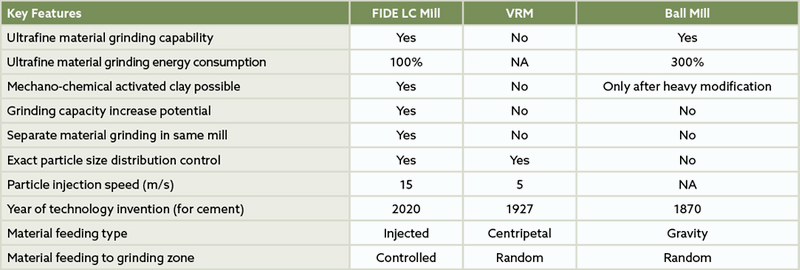
In conventional VRMs, material is fed centrally onto the grinding table and distributed stochastically to multiple roller grinding zones by centripetal force. This distribution method also imposes an upper table speed limit – too fast and any material is thrown off – limiting grinding efficiency and throughput. In a low-carbon grinding mill (see image below), material is injected directly into each roller grinding zone under controlled velocity and collected immediately after grinding. This reduces internal circulation, increases grinding pressure and eliminates over-grinding losses.
Independent control of roller speed, table speed and feed rate enable increased shear forces, promoting MCA previously unattainable in VRM-based systems. The controlled injection feed and collection (CIFAC) system also allows different materials to be fed to different grinding zones, enabling simultaneous and separate grinding of different material types or hardness in a single mill.
Finally, the CIFAC negates the traditional VRM table-speed limitation, permitting more than three times faster throughput for the LC Mill, resulting in a one-third smaller unit for a similar capacity and therefore production cost savings.
Key benefits of this approach include:
- Significantly higher energy efficiency compared with ball mills – a 300% increase
- The ability to produce finer and narrower particle size distributions – an 80% improvement
- Flexible processing of multiple materials simultaneously within a single mill
- Enhanced shear forces to promote MCA
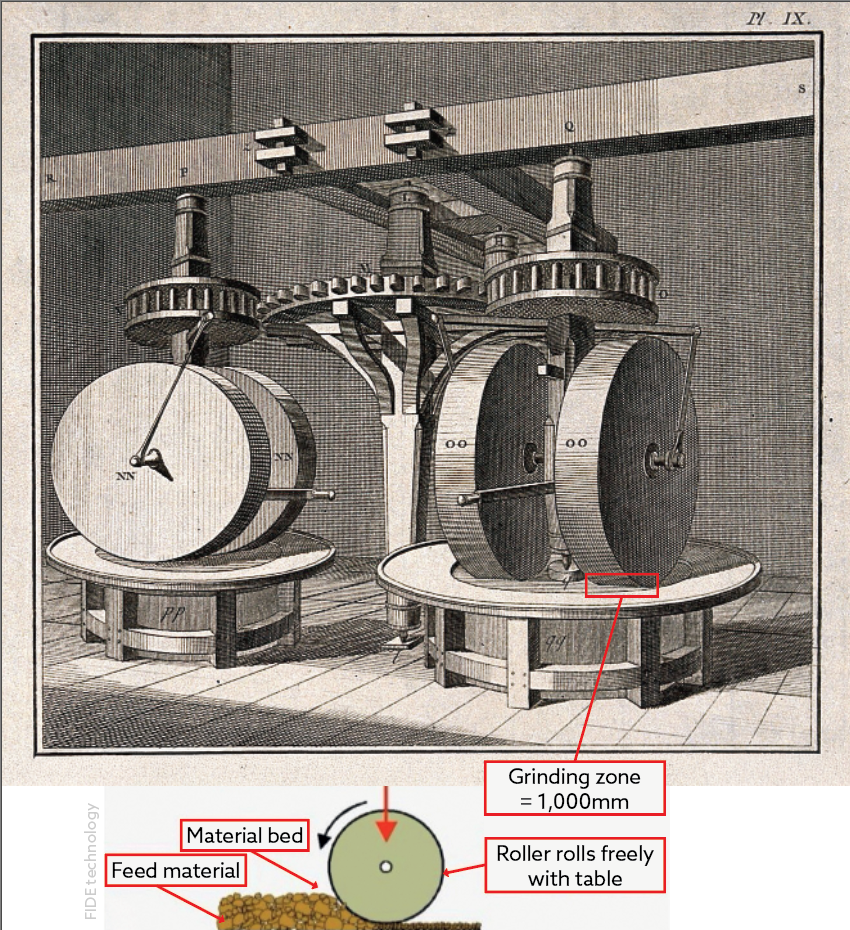
The vertical roller mill grinding principle shows compression-based grinding between rollers and a table with a larger grinding zone
© FIDE technology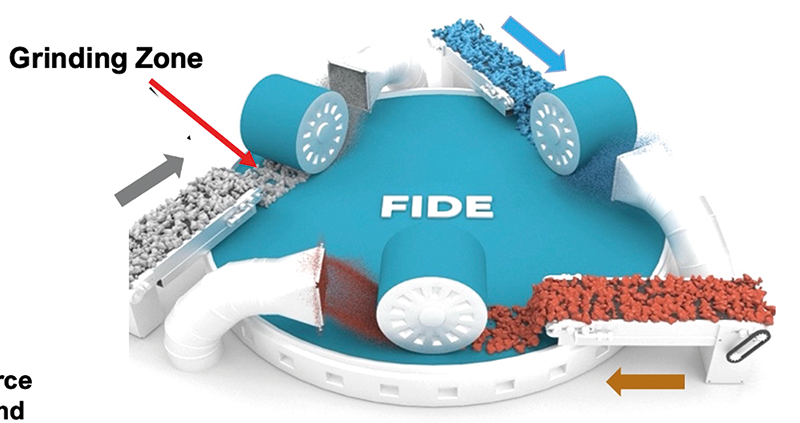
Experimental validation and scale-up
A proof-of-concept FIDE LC Mill with a capacity of 0.15t/h has been operated at research centre EPFL in Switzerland, as shown opposite. The system successfully processes 13 different materials, including clinker, slags, clays, limestone, pozzolans and end-of-life concrete.
Target median particle sizes (D50) of 2-20μm were achieved, meeting ultrafine specifications unattainable by commercial VRMs and comparable to high-energy ball mills. Compared with laboratory ball milling of the same clinker, the FIDE LC Mill produces a 50% narrower particle size distribution (see graph below) – an important characteristic for multi-component, low-clinker cements.
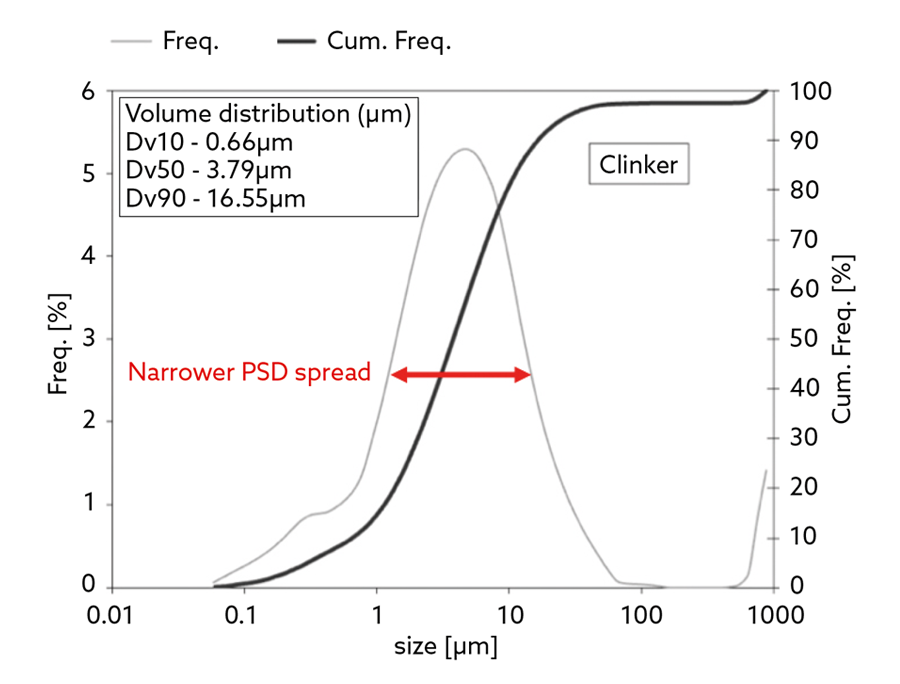
Ultrafine clinker with enhanced specific surface area
© FIDE technologyFor equivalent particle sizes, specific surface area increases by up to 255%, attributed to increased ultrafines content and changes in particle morphology. These characteristics translate into increases in early compressive strength of up to 145% in mortar testing. Mechano-chemical activation effects were also observed for coal gangue, low-grade clays, pozzolanic rocks and clinker, indicated by increased amorphous content and reactivity.
New low-carbon cements were also manufactured using the LC3-50 recipe – typically 40% CO₂ reduction over ordinary Portland cement. This used coal slag that was ground with the FIDE LC Mill and produced an impressive 28 days compressive strength of over 60MPA exceeding standard Ordinary Portland Cement values.
Scale-up is under way. A system with 10 times the proof-of-concept capacity has been manufactured (see image below) and prepared for industrial deployment, while a 200t/h design is under development to compete directly with conventional ball mills and VRMs (see table below).
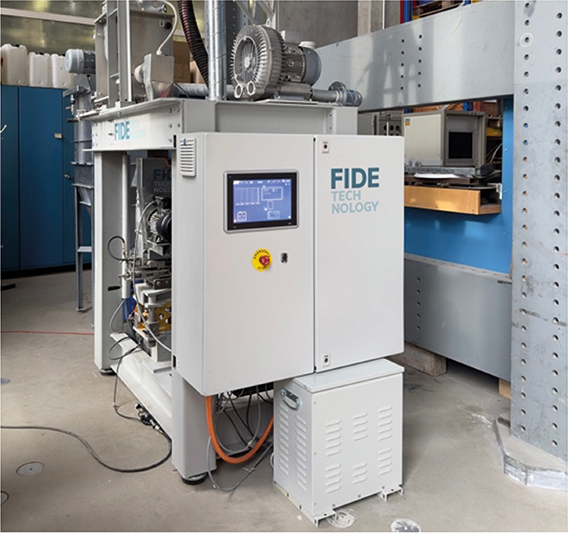
Proof-of-concept LC Mill at EPFL in Switzerland, with a 0.15t/h capacity, used for independent grinding and activation trials
© FIDE technology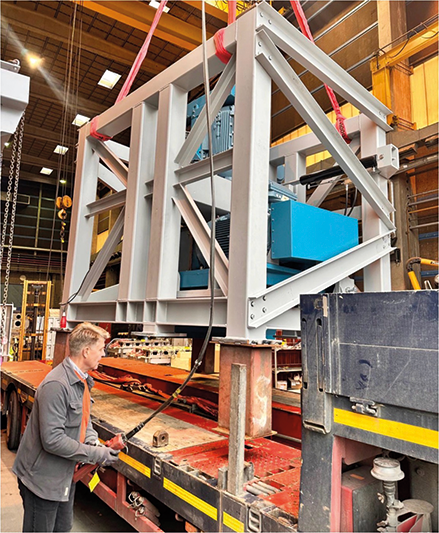
Scaled-up LC Mill for industrial deployment, 10 times larger (1.5t/h capacity) representing the first step towards full-scale commercialisation
© FIDE technologyConstructing a value chain
Improved grinding technology has implications across the construction value chain. By enabling higher levels of SCM clinker substitution, while maintaining or improving performance, the LC Mill could significantly reduce embodied CO₂ in construction. A 15% global adoption rate could reduce annual CO₂ emissions by approximately 495Mt – equivalent to eliminating all European passenger car emissions.
Improved grinding efficiency could reduce global electricity consumption by around 27TWh annually, equivalent to roughly 50% of Germany’s peak power demand.
The ability to activate low-grade and waste materials would reduce reliance on primary raw materials and support circular economy objectives. At 50% clinker replacement, Europe alone would require approximately 150Mt of SCMs annually, which could include the stockpiles of industrial and recycled waste materials such as coal fly ash, steel and mining slags plus end-of-lifetime concrete.
Grinding innovation also underpins emerging circular construction technologies. Start-ups such as everox, Brimstone, Carbon Upcycling, Queens Carbon, Carbon To Stone and Resilco all rely on advanced grinding and activation to produce low-carbon binders, recycled aggregates and CO₂-negative materials.
The green cement start-up sector has attracted approximately US$750mln in venture capital investment across 28 companies in recent years – as reported by Crunchbase in August 2024 – and many are supported by the major cement producers. Flexibility and high performance in their critical grinding process are being demanded by these start-ups as they scale up production.
Historically, advances in crushing and grinding have enabled major societal developments – from food security and urbanisation to metallurgy, medicine and modern infrastructure. Today, grinding again sits at the intersection of materials science, energy efficiency and environmental performance.
As industry seeks to decarbonise while meeting rising demand for materials, the ability to process diverse feedstocks efficiently and sustainably will be critical. Innovation in grinding technology therefore represents not only an engineering challenge, but a key enabler of a resilient, low-carbon and circular materials economy.
Special thanks to Professor Karen Scrivener and her team at EPFL.