Driving forward
Exploring a patent for recycling tyre material using microwave pyrolysis.
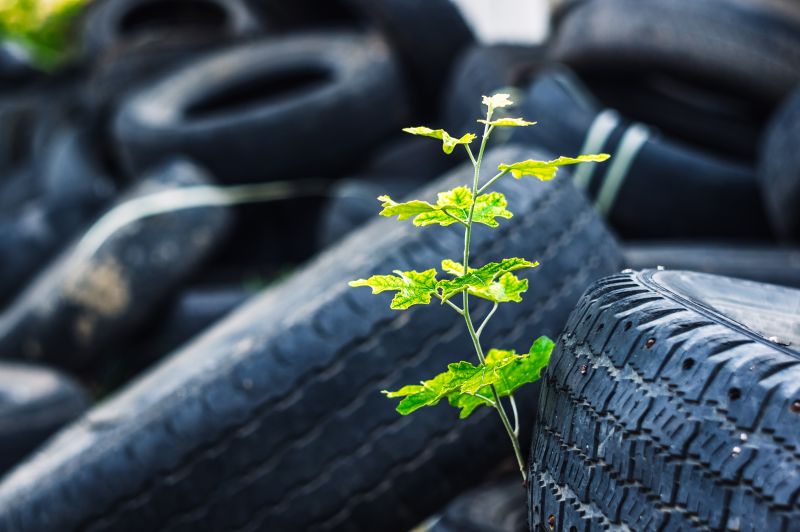
Vehicle tyres have traditionally been made predominantly of synthetic rubber and carbon black. Modern tyres, in contrast, often contain a variety of different devices and material layers selected to improve efficiency, safety and environmental impact.
For instance, tyres can now include different types of rubber, thermoplastic and thermoset polymers (including PET, polyurethanes and epoxy resins); aramids (e.g. Kevlar); minerals (e.g. silica); electronic device components made from metals and piezoelectric materials; shape-memory alloys; and biomass (from dandelions to rice husk).
While these different combinations can significantly improve tyre function, there can be an impact on recyclability, as it has become increasingly difficult to separate and depolymerise tyre components to produce high-quality recycled materials.
European patent EP4196548B1, granted to Microwave Solutions GmbH in March 2025, claims protection for a pyrolysis method of recovering different material components using thermal decomposition.
In the claimed method, the tyre material is delivered to a pyrolytic chamber, where it is exposed to a controlled atmosphere and heated to the decomposition temperatures of the differing material components using microwave radiation.
This involves applying a variable-power microwave radiation at frequencies between 300MHz and 2,500MHz, to sequentially vary the temperature in the pyrolytic chamber to predefined temperatures. These correspond to the decomposition temperatures of the different material components. The sequential increase in the decomposition temperature results in the sequential decomposition of differing components.
The recovered material components are then separately collected through successive exit ports, at points of increasing product temperature along the chamber’s length.
According to the patent, microwave technology has previously been used to recycle tyres. However, earlier processes used multiple magnetrons each operating at the same power and wavelength, and the temperature was controlled by varying the power supply (for example, turning individual magnetrons on and off). The inventors say this makes it difficult to yield high-quality pyrolytic oils, hydrocarbons, monomers and other chemicals. In contrast, the claimed process is said to enable high volumes of tyre material to be processed while improving the yield and quality of the various recovered components.
In the patented process, microwave radiation and temperature in the chamber are not simply altered in discrete or incremental steps, e.g., by switching on and off magnetrons. Instead, the applied microwave radiation comprises one or more radiation frequencies between 300MHz and 2.5GHz, and is adjusted in a precise manner over the temperature range of the pyrolysis method.
Different tyre components are extracted in different microwave reactor zones that operate independently from each other, with the radiation power applied in each zone tailored to the targeted component’s decomposition temperature. This is possible because the various material components exhibit different boiling points and microwave absorption properties.
According to the patent, it is possible to heat the tyre material to the specific temperatures necessary to separately recover chemicals like isoprene, benzene, toluene, p-xylene, m-xylene, o-xylene, styrene, DL-limonene and phthalates, which can be sensitive to temperature degradation. These components can then be reused as solvents and petrochemical feedstocks.
In one example, the inventors describe how a yield of 33% DL-limonene was achieved by pyrolysing vulcanised natural rubber using a vacuum at 10kPa, microwave radiation at 915MHz in a L-band, and a pyrolysis temperature of 350-370°C. This is compared to a DL-limonene yield of only 16.6% achieved by an existing process described in the literature.
In addition, the patent also claims protection for the pyrolysis reactor itself and explains how the conditions inside it can be controlled. For example, the patent describes active control of the pressure and chemical atmosphere in the chamber. Reactive gases, such as syngas (a mixture of hydrogen and carbon monoxide), can be used to promote desired chemical reactions or increase the yield of certain targets. Such reactive gases may themselves be formed during pyrolysis and recycled through the reactor.
The temperature can preferably be controlled from -20°C to 750°C, while microwave radiation is advantageously selected from a VHF-band, S-band, UHF-band and/or L-band of the microwave spectrum.
The multiple exit ports along the chamber’s length allow off-gases to be collected and the physical separation of different volatile products through corresponding individual condenser systems. An airlock system or screw feeder at one end of the chamber also permits solid products to be discharged.
The inventors note that the patented process and reactor are also suitable for the decomposition of other types of scrap material, including unvulcanised tyres or rubber (known as ‘green tyres’), which are challenging to recycle using mechanical recycling processes or conventional pyrolysis.
The patent is available online.