Cottonseeds offer PFAS-free finish to fabrics
A humble cotton harvesting by-product could prove a safer, more sustainable and cost-effective alternative to chemicals.
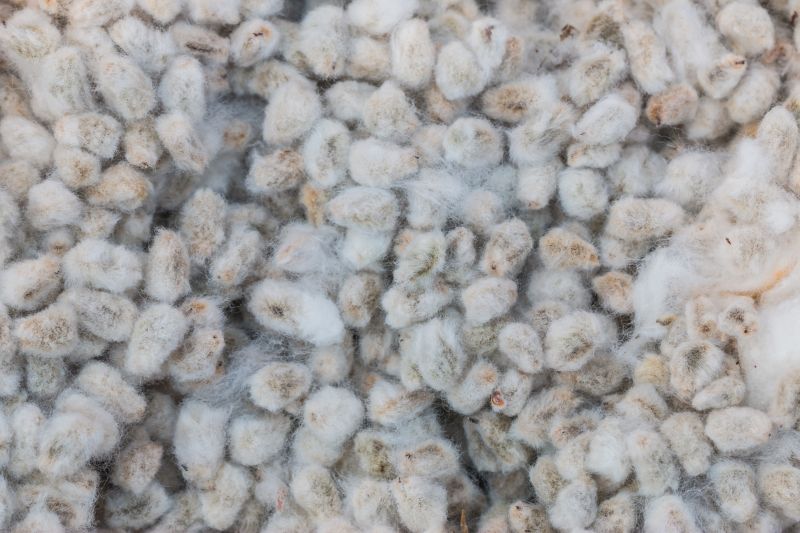
The process for harvesting cotton and creating fabric for textiles includes collecting the wispy cellulose fibres of the cotton boll, removing the cotton seeds interspersed in the fibres, spinning the cotton into yarn, weaving the yarn into fabric and then finishing the fabric with a variety of chemicals that alter its physical properties.
However, the chemicals traditionally used to keep these fabrics smooth, durable and water-repellent can linger in the environment and on our skin.
The finishing techniques that make cotton resistant to wrinkling and stretching often involve treatment with formaldehyde-based resins, which bind to cotton’s long cellulose fibres to form chemical bridges. While coatings applied to give water repellency can contain per- and polyfluoroalkyl substances (PFAS).
In a bid to find an alternative, researchers at North Carolina State University, USA, have looked to the cotton fibre’s own by-product – cottonseed oil.
'Cottonseed oil has one of the most consistent compositions,' says research lead Professor Richard Venditti. 'With its predictable unsaturation, we can design tightly controlled structures for finishes.'
The team capitalised on this predictable chemical structure using a process called epoxidation, where reactive epoxy groups are introduced into the cottonseed oil molecules along the long carbon chains. When epoxidised cottonseed oil (ECSO) is chemically grafted onto cotton fabric and filter paper, the epoxide groups allow the molecules to bond directly with the fibres and with each other, making the fabric hydrophobic.
The epoxy groups also create oil molecule bridges between the cellulose fibres, making the fabric resistant to wrinkling.
The oil can be applied in either a stable water emulsion via a pad-dry-cure process (using 'environmentally friendly' emulsifiers), or via a solvent. Venditti and his team are currently optimising the application parameters, having experimented with different reaction times and varying amounts of catalyst and ECSO.
Testing shows promising results, they report. After weighing the samples and using infrared spectroscopy to confirm successful bonding, the team examined how well the samples repel water. Using a high-speed camera, they have measured water penetration and water drop contact angle – the higher the contact angle, the better the fabric’s hydrophobicity. ECSO-treated samples showed contact angles of up to 125°, while untreated fabric fully absorbed water droplets.
Venditti is positive about the results, which he says 'show dramatic improvements in the properties of the fabric'.
When comparing their process to other ‘green’ finishing methods, Venditti highlights the renewable, biodegradable, non-toxic and non-allergenic properties of their materials and finishes. 'The application of cottonseed oil to cotton fabrics makes this very circular,' he says. They are also exploring different methods to react the epoxidised cottonseed oil.
Beyond safety and environmental benefits, ECSO offers economic advantages, he says. By repurposing the cottonseed oil harvested alongside the fibres, the process could, if proven commercially viable, reduce waste and lower costs associated with conventional finishing agents.
Venditti is confident that ECSO can be adapted for industrial textile finishing, 'since we are developing the chemistry on pilot plant application equipment and are using a water-based application method'.
Further process development is already underway. Alongside optimising the application of ECSO to fabrics, 'we are exploring different emulsion systems and reactants to combine with the cottonseed oil for the finishing process', says Venditti. The team further plans to evaluate durability, tear strength, long-term wear and resistance to environmental factors.