Building in change
The built environment needs to adapt to the world of changing climate and weather patterns.
According to the EU’s Earth observation service, Copernicus, the world is predicted to reach the 1.5°C global warming limit by 2030, a decade earlier than expected. This has a large range of effects on the built environment and surrounding infrastructure, such as:
- Components will need a greater thermal range – this influences design choices, such as thermal expansion.
- Greater summer temperatures due to urban heat island (UHI) effects – this is already well understood in places such as China, the US and the Middle East. Streets and building exteriors must be designed and adapted so pedestrians can remain comfortable in the summer.
- Thermal overheating in the summer – the risk of mortality is being recognised for future building codes, but it is also necessary to retrofit existing building stock to minimise overheating and improve cooling overnight. This is especially true for buildings in UHI zones and where night temperatures are elevated.
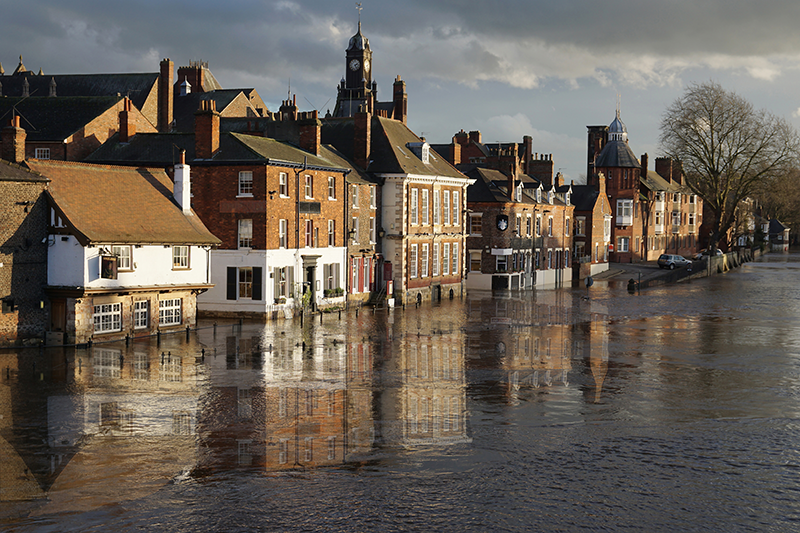
- Increased flood risk in many UK regions – via direct run-off, or delayed surges of water entering the larger waterways and being greater than the design capacity of existing flood defences.
- Impact on coastal and estuarine communities and their upstream buffer zones – due to a combination of stronger storms, lower pressure leading to higher high-tide events and storm surges, with river levels increasing due to greater rainfall.
All of the above have dramatic consequences for the built environment, and there is a need to adapt the way we design, construct and use buildings.
The UK’s Met Office has developed detailed models for future climate effects (UKCP18). These are reviewed and refined periodically to keep pace with emerging data from decade to decade. This assists in policymaking and risk decisions.
UKCP18 high-emission scenarios and emerging local projections confirm that materials specified today may face a more extreme climate in the future. For instance, the heat stress in London’s climate could increase by 7% by 2080, increasing the thermal load on materials.
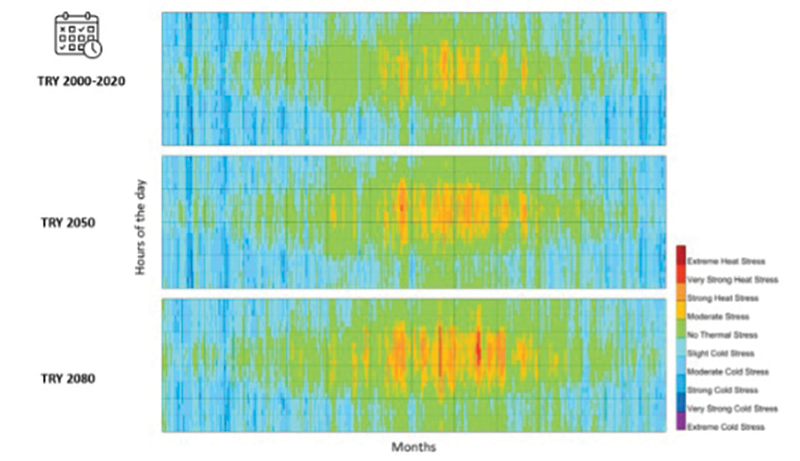
Also, despite drier summers, heavy rainfall events are likely to be more intense, leading to greater risk of flash flooding. In addition, an increase in near-surface windspeed is anticipated for the second half of the 21st Century.
An increase in windspeed alone requires a review of wind-loading calculations on tall buildings for stability, right through to wind-funnelling calculations for assessing urban canyons and pedestrian safety in dense areas.
If we want to protect our buildings from adverse effects relating to climate change, we need to get better at design, specification and testing now.
We need to develop a culture of holistic design-risk assessment, rather than just relying on conformance to standards. There are already many failures in building materials and products because the service environment has not been adequately considered, specified and demonstrated at the design stage.
Copernicus
Copernicus is the Earth observation component of the EU’s space programme. It draws information from satellite and in situ (non-space) data.
Sentinel-4 is the first geostationary Copernicus mission, and it was successfully launched on 1 July 2025. It is designed to provide data for atmospheric composition monitoring. Its objective is to monitor key air quality trace gases and aerosols over Europe at high spatial resolution with a fast (hourly) revisit time.
With a fleet of seven Sentinel satellites, advanced sensors and models, Copernicus provides a massive amount of free data and information services daily to hundreds of thousands of users.
Specific impacts
Polymers
Polymers are typically the most temperature-sensitive materials in a building façade. However, there are many failures in façades, because no thought is given to the maximum foreseeable service temperature. The Centre for Windows and Cladding Technology’s Standard for Systemised Building Envelopes Part 2 provides foreseeable service temperature ranges, which are often ignored by designers and specifiers.
The cause of failures in polymer materials at elevated temperatures can include high thermally induced loads and differential expansion from high coefficients of thermal expansion. This results in delamination between different layers, or distortion in panels due to expansion between fixings.
Other materials failures can come from the adhesive bond strength deteriorating because of adhesive softening above the glass-transition temperature; plasticiser migration and acceleration between materials, resulting in distortion and flowing of glazing sealants; cracking in polycarbonate glazing; and thermal degradation with associated discolouration and mechanical failures.
Timber
While many building materials and systems require small adjustments to future-proof them for a changing climate,
such as the expansion gaps in road bridges for a hotter and colder summer-winter temperature range, timber faces a double challenge.
An increase in rainfall may lead to prolonged wetting for timber in exterior and ground-contact situations. This affects the risk of decay in fencing and landscaping timbers. On the other hand, the drier regions may receive higher doses of UV, altering the service life of paints and coatings.
A less commonly considered climate change effect is impact on wind patterns. This appears to be more complex to model, but the UKCP18 projections suggest that, if storm events become stronger and more numerous, high winds may be associated with driven rain.
If there is greater variability in wind direction, the driven rain may reach walls that would ordinarily be protected or at low risk of weathering. For example, north-facing or east-facing cladding is usually less weathered than west-facing.
Glass
Glass can play an important role in mitigating the impact of climate change. For example, high-performance solar-control glass can mitigate overheating in residential buildings. While laminated glass can be used as a flood-defence barrier in the form of special laminated glazing.
When correctly specified, laminated glass can also be tailored to satisfy a range of bespoke loading requirements, including hydrostatic loads and debris impact resistance, as well as traditional barrier loads. Correctly specified laminated glass often remains as a temporary barrier until replaced, because of its post-breakage containment properties and, depending on interlayer selection, load-sharing properties.
The Kendal Flood Risk Management Scheme project in Cumbria is a good example of a high-performance, glass-panel flood wall that incorporates self-cleaning properties. It is combined in a 35mm-thick, laminated configuration with an interlayer, so the glass is resistant to dynamic loading and the impacts of flood waters even if fractured. This is the first of three locations within the town centre, comprising part of the 6km of flood walls and embankments. Once complete, it should reduce the risk of flooding for more than 1,480 homes and 1,100 businesses.
In terms of standards, both ISO and CEN have requested their technical committees to review standards and, where applicable, adapt them for climate change, effectively ‘future-proofing’ them. There have been changes to test methods, such as for radiation levels, temperatures and loadings. The committees that cover glass in buildings – ISO/TC 160 and CEN/TC 129 – have so far only had tentative discussions on this.
Under the so-called London Declaration, the British Standards Institution has asked similar questions of the national technical committees.
Regarding B/520, which covers glass and glazing in buildings, the committee has been working with BSI Climate Advisors on how to adapt the BS 6262 series. Instead of changes to test regimes, or similar, this is more to raise awareness when specifying glass for buildings. Work is about to start to revise the BS 6262-2, which deals with light and energy. This will shift the emphasis from energy only to carbon.
Some glass options are now made with high recycled content, alternative fuels and renewable energy. Glass can also provide enhanced coating or interlayer options to provide additional benefits, including manifestation, decorative patterns, low reflection, self-cleaning, high clarity, bird safety and even corrosion resistance.
Flash flooding
Flash flooding is one illustrative example of where a new approach is needed.
It represents an increasingly critical climate-driven hazard for the built environment. It imposes short duration, but extremely high, energy loads that many construction products were never designed to withstand.
Unlike prolonged inundation, flash-flood exposure is defined by a compound loading regime acting simultaneously. Rapid hydraulic pressure and high-flow velocities generate significant mechanical stresses on construction materials, while debris carried by floodwaters introduces impact forces and localised damage.
Simultaneously, sudden saturation overwhelms drainage pathways, enabling rapid water ingress and disrupting material interfaces that typically rely on controlled moisture exposure.
The components most vulnerable to this regime include external wall systems, cladding assemblies, pavements, joint sealants and below-ground elements.
Failures often originate not from catastrophic structural collapse but from loss of integrity at joints, interfaces and protective layers. These early points of weakness can accelerate post-event deterioration and compromise long-term performance.
Concrete and other cementitious products, valued for their strength and durability, experience accelerated deterioration under flash-flood conditions. Sediment laden flows increase surface abrasion, while floodwaters frequently contain chlorides, sulphates and hydrocarbons that initiate chemical attack. These contaminants promote corrosion of embedded reinforcement and weaken surface layers. Repeated wetting and drying cycles following successive events further exacerbate microcracking and reduce long-term durability.
Polymer-based products – including membranes, coatings and sealants – are particularly sensitive to rapid moisture transitions. Sudden immersion followed by forced, or uneven, drying can cause swelling, plasticisation, loss of adhesion and measurable reductions in mechanical performance. Although damage may not be immediately visible, cumulative degradation over multiple flood events can significantly shorten service life.
Timber and bio-based materials, increasingly specified for their low-embodied carbon, also require careful consideration. Repeated wetting without adequate drying promotes biological degradation, dimensional instability and loss of structural capacity. In these systems, resilience depends as much on detailing protective layers and drainage design, as on the base material itself. However, novel treatments that minimise moisture uptake, such as modified wood, can help reduce risk.
A key challenge lies in the mismatch between current product testing regimes and real flash-flood exposure.
Existing standards typically isolate mechanical, hydraulic or chemical effects, rarely capturing their combined and transient nature. As flash flooding becomes more frequent, product design must shift from assuming water exclusion to ensuring performance under rapid wetting, contamination and recovery. Enhanced abrasion resistance, reduced permeability and robust interfaces, as well as clearly defined post-flood performance criteria, will be essential for ensuring materials remain fit-for-purpose in a changing climate.
The role of building assessment
In light of the stark reality of climate change and the built environment’s significant contribution to greenhouse gas emissions, a number of initiatives have been established, such as the UK Net Zero Carbon Buildings Standard (UKNZCBS) or BREEAM.
The UKNZCBS launched a pilot in April 2025 and provides a rigorous framework to address this. It imposes evidence-based limits on upfront embodied carbon, operational energy, peak demand and refrigerant impacts, which are all benchmarked against the UK’s remaining Carbon Budget. This is to ensure that the built environment sector remains on a credible 1.5°C-aligned pathway. Future iterations of the standard will extend to full lifecycle embodied carbon, directly influencing material choices today.
Carbon reduction alone does not guarantee longevity. BREEAM’s Designing for Durability and Resilience explicitly requires designers to assess projected climate impacts, higher temperatures, increasing driving rain and freeze-thaw cycles – and specify accordingly. It encourages risk assessments and protective measures to reduce repair frequency.
Similarly, complementary schemes like the WELL Building Standard prioritise material transparency and low volatile organic compound formulations, indirectly improving resilience to moisture-related degradation and indoor air quality under heat-stress conditions.
Bioclimatic design plays a pivotal role in future-proofing material performance. Leading engineers such as AKT II now routinely model buildings against UKCP18 high-emission scenarios and emerging UKCP local projections. Climate appraisal with future projections of hazards, combined with thorough building and structure analysis, is being increasingly requested by clients and recommended in recent years. These simulations inform selection of more breathable insulation systems, or phase-change materials that mitigate peak heating loads without degradation.
Rising ambient temperatures and more frequent heatwaves will increase the magnitude and frequency of thermal expansion cycles in building elements, while more intense solar irradiance can create sharp temperature gradients across sections, such as between sunlit and shaded faces of steelwork. This drives differential movement and localised warping. Over time, these repeated expansion-contraction cycles can amplify serviceability issues, causing misalignment at connections, racking of façade frames, sealant fatigue and loss of weather-tightness.
This is especially a concern where materials with different coefficients of thermal expansion are coupled – steel-to-glass, aluminium-to-timber, or composite build-ups.
In practice, future-facing climate appraisal should therefore inform not only material selection but also the detailing strategy, allowing for larger movements through joints and tolerances, specifying sliding/isolating fixings where appropriate, and avoiding constraints that lock in thermal strain as climates warm.
As the UK climate shifts, wind becomes a bioclimatic design variable in its own right – not simply as an ultimate limit-state check, but a long-term driver of envelope durability, comfort and operational performance.
The Eurocode baseline for safety still holds up, but testing is needed to identify whether the site’s microclimate meaningfully changes the governing pressures – terrain roughness, coastal exposure, topography, nearby massing and shielding, and prevailing wind directionality.
Where there is robust evidence, more specific understanding can avoid over-conservatism and reduce material intensity without compromising resilience – unlocking embodied-carbon savings through leaner stabilising strategies (for example, fewer stiffening walls or less onerous foundations) while keeping drift and deflection within serviceability limits.
At the same time, climate change pushes the conversation beyond a single ‘worst gust’ towards how storminess and wind-driven rain affect a façade over decades. More frequent high-wind events and heavier rainfall can increase cyclic demands on brackets, anchors and seals, raising the risk of loosening, fatigue, rattle and progressive loss of weather-tightness if details rely on tight tolerances or brittle interfaces.
The most effective response is often targeted detailing, rather than wholesale upsizing, i.e. designing for robustness and redundancy in fixings, specifying fatigue- and corrosion-resistant interfaces particularly at dissimilar metal junctions, and treating movement, drainage paths and pressure equalisation as first-order design choices so the envelope remains serviceable under repeated wind episodes as conditions evolve.
Accelerating the supply of suitable low-impact products is equally critical. The recently formed Emergent Sustainable Built Environment Material Network by Innovate UK exists to improve adoption of bio-based technologies, valorised waste and reused/repurposed materials across UK supply chains.
Overcoming barriers and scaling innovations is central to this network, alongside other open-source efforts such as Henning Larsen’s freely available Material Catalogue. This catalogue provides embodied carbon benchmarks and durability data for hundreds of products. Together, these efforts ensure that the materials we specify today will support resilient, net-zero buildings in the future.
How nature can lend a hand
With accelerating climate change, resource constraints and rising expectations around health and wellbeing, nature should not be viewed as something buildings resist. Instead, nature can be actively harnessed to support building performance, longevity and societal value. For construction materials engineers, this represents both a challenge and an opportunity – to design materials and systems that work with natural processes rather than against them.
Nature already offers powerful models for resilience. Translating these principles into construction materials has led to growing interest in bio-inspired and bio-based solutions. This includes mineralisation processes in cementitious systems to plant-inspired surface textures that manage moisture, heat and pollution. These approaches are particularly relevant as buildings face more intense rainfall, higher temperatures and poorer urban air quality.
A key area where nature can directly support buildings is through functional surfaces and materials. Bioreceptive concretes and renders, for example, deliberately encourage colonisation by mosses, algae, or lichens. Far from being purely aesthetic, such systems can moderate surface temperatures, retain moisture and enhance biodiversity in dense urban settings.
Similarly, minerals-based materials incorporating photocatalytic phases can remove air pollutants by harnessing light, often UV radiation from the Sun. Natural phases, such as sheep’s wool, can irreversibly react with pollutants like formaldehyde, permanently removing them from the environment.
Studies such as A rapid method for investigating the absorption of formaldehyde from air by wool in the Journal of Materials Science, and another called Influence of eco-materials on indoor air quality in the journal Green Materials, showcase this potential alongside other materials including MDF and lime mortar.
The study on Improvement of indoor air quality by MDF panels containing walnut shells in the journal Building and Environment reveals how other organic materials enhance building products, enabling them to passively and reversibly absorb air pollutants for healthier indoor environments without additional energy demand.
Nature-aligned thinking is also critical for durability and heritage safety. Many historic materials evolved in balance with their environment, relying on vapour permeability and sacrificial weathering rather than impermeable barriers. Relearning these lessons is essential as climate change places new stresses on both modern and historic structures.
Understanding mineralogical processes such as carbonation, reactions with acidic gases like sulphur dioxide and oxides of nitrogen, and moisture transport enables engineers to design materials that meet the needs of a changing environment.
Finally, embracing nature in construction materials supports a broader shift towards regenerative design. Materials that sequester carbon, support ecosystems, or improve air quality allow buildings to become part of a positive environmental system rather than a net burden. For the construction materials community, the task ahead is not simply to reduce harm, but to actively design materials that enable buildings to adapt, protect and enhance their environment, just as nature has done for millennia.
As our climate shifts towards hotter summers, wetter winters and more frequent extreme weather, the materials we select must drive down embodied and operational carbon, and remain fit-for-purpose over a building’s lifetime under evolving environmental stress. With good design practice that considers the projected environment, failures in any materials or products can be prevented.